Bangladesh–Japan Economic Partnership: Five Sectors That Can Transform the Economy
A Strategic Roadmap for Investment, Industrialisation and Sustainable Growth, 2026–2031

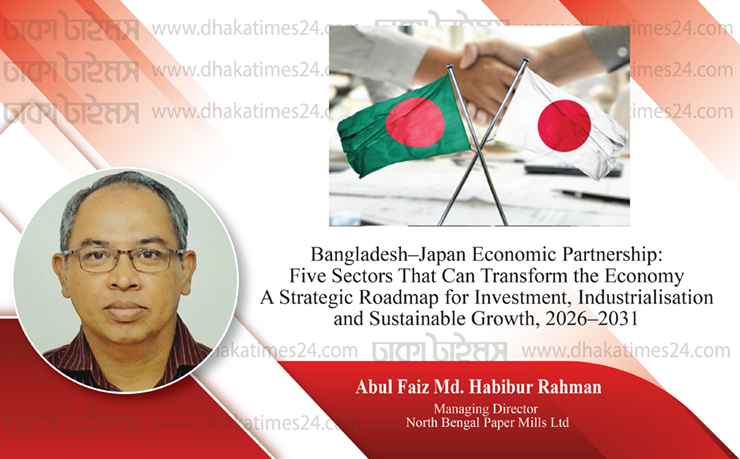
By turning investment commitments into productive industries, Bangladesh can create jobs, diversify exports and accelerate its journey towards a competitive, technology-driven economy.
development. As the country seeks to strengthen its industrial base, diversify exports and attract high-quality foreign direct investment (FDI), its economic partnership with Japan offers an important opportunity. Prime Minister Tarique Rahman’s call for Japanese investment in five priority sectors—automobile manufacturing, energy, technology and space cooperation, high-speed rail and logistics, and agro-processing—could become a cornerstone of Bangladesh’s next phase of economic transformation. The challenge now is to translate investment interest into factories, infrastructure, technology transfer, skilled employment and higher export earnings. Achieving these goals will require coordinated action by the government, Japanese investors, financial institutions and the private sector.
1. Automobile Manufacturing: Building a New Industrial Frontier
Bangladesh’s growing domestic market, expanding workforce and strategic location provide a foundation for developing an automobile manufacturing industry. Japanese companies, internationally recognised for their engineering expertise, production efficiency and technological innovation, could play a transformative role.
Rather than relying heavily on imported completely built-up vehicles, Bangladesh should encourage local assembly and gradually develop domestic manufacturing capabilities. Priority areas could include passenger vehicles, commercial vehicles, motorcycles, electric vehicles, batteries and automotive components.Key policy actions should include:
Establishing dedicated automobile and automotive-component industrial zones.
Offering predictable, performance-based incentives for investment and local production.
Encouraging joint ventures between Japanese manufacturers and Bangladeshi companies.
Developing local suppliers of tyres, batteries, wiring systems, electronics and other components.
Introducing vocational training in automotive engineering, robotics, quality control and electric-vehicle maintenance.
Developing charging infrastructure and standards to support electric mobility.
The government should prepare a clear automotive industrial policy with measurable targets for local value addition, employment, technology transfer and exports.
Expected outcome: A competitive automotive industry could reduce dependence on imported finished vehicles, create skilled jobs, deepen industrial linkages and establish Bangladesh as a potential regional manufacturing hub.2. Energy: Securing the Foundation of Industrial Growth
Reliable and affordable energy is essential for attracting Japanese investment and strengthening Bangladesh’s industrial competitiveness. Energy shortages, fuel-price volatility and uncertainty over long-term supply can undermine investment decisions, increase production costs and weaken export performance.
Bangladesh should therefore pursue a balanced energy strategy combining efficient conventional power generation, renewable energy, energy storage and modern transmission infrastructure.
Japanese investment could be encouraged in solar power, rooftop solar systems, battery storage, energy-efficient industrial equipment, smart grids, waste-to-energy projects and modern power-generation technologies. Cooperation in LNG infrastructure and gas-based generation may also contribute to energy security where commercially viable and consistent with national energy policy.Priority measures include:
Expanding rooftop solar in industrial zones, factories and commercial buildings.
Developing utility-scale solar projects with transparent procurement and competitive pricing.
Improving electricity transmission and distribution to reduce system losses.
Encouraging energy storage and smart-grid technologies.
Promoting energy audits and efficiency improvements in industrial enterprises.Establishing predictable regulations for independent power producers and private-sector energy investment.
Bangladesh should also assess projects carefully for affordability, foreign-exchange exposure, environmental impact and long-term financial sustainability.
Expected outcome: A more reliable, diversified and efficient energy system would improve industrial productivity, strengthen investor confidence and support Bangladesh’s transition towards sustainable economic growth.3. Technology and Space Cooperation: Moving Towards a Knowledge-Based Economy
The next stage of economic growth will depend increasingly on technology, innovation and human capital. Bangladesh has an opportunity to move beyond traditional manufacturing by attracting Japanese investment in advanced electronics, information technology, artificial intelligence (AI), robotics, semiconductor-related activities and digital infrastructure.
Cooperation should focus on practical applications that improve productivity and create high-value employment. Potential areas include electronics manufacturing, cloud services, industrial automation, cybersecurity, digital public services, satellite applications and geospatial technology.Priority initiatives could include:
Developing technology parks designed to attract Japanese companies and research institutions.
Establishing joint research and innovation programmes between universities and Japanese industries.
Expanding technical education in electronics, software engineering, robotics and AI.
Encouraging investment in datacentres and secure digital infrastructure, subject to reliable power and appropriate regulation.
Promoting satellite-based applications in agriculture, disaster management, fisheries, navigation and environmental monitoring.
Supporting technology start-ups through investment facilities, incubators and industry partnerships.
Bangladesh should prioritise technology transfer and workforce development rather than merely hosting foreign companies. Investment agreements should encourage training, research collaboration and the gradual development of local technological capabilities.
Expected outcome: Stronger technological cooperation could raise productivity, create skilled employment, diversify exports and help Bangladesh participate in higher-value segments of global supply chains.4. High-Speed Rail and Logistics: Connecting Markets and Reducing Costs
Efficient transport and logistics infrastructure is fundamental to national competitiveness. Delays in moving goods, congestion at ports and inadequate multimodal connectivity can increase business costs and discourage foreign investors.
Japan’s experience in railway engineering, urban transport, logistics management and infrastructure maintenance offers valuable opportunities for Bangladesh. However, high-speed rail should be considered only after rigorous feasibility studies establish its economic viability, affordability and passenger demand.
In the near term, Bangladesh could prioritise railway modernisation, freight services, port connectivity, intermodal logistics hubs and improved links between industrial zones and major economic centres.
Key actions include:
Conducting comprehensive feasibility studies for high-speed and higher-speed passenger rail.
Modernising existing railway lines, signalling systems and safety infrastructure.
Improving rail connections to Chattogram and other major ports and industrial centres.
Developing logistics hubs, inland container facilities and multimodal freight terminals.
Introducing digital cargo tracking and modern customs-clearance systems.
Strengthening public-private partnerships with transparent risk-sharing arrangements.
Establishing long-term maintenance and technical-training programmes with Japanese partners.
Infrastructure projects must be assessed against lifecycle costs, debt sustainability, land requirements, environmental considerations and expected economic returns.
Expected outcome: Better rail and logistics connectivity could reduce transport costs, improve supply-chain reliability, support regional development and make Bangladesh more attractive to export-oriented investors.5. Agro-Processing: From
Agricultural Production to Higher-Value Exports
Agriculture remains central to Bangladesh’s economy, employment and food security. Yet the country can capture significantly greater economic value by moving beyond the production and sale of raw agricultural commodities towards modern processing, preservation, packaging and distribution.
Japanese investment could help modernise food processing, cold-chain logistics, quality assurance and agricultural technology. Potential opportunities include processed fruits and vegetables, frozen foods, fish and seafood, dairy products, ready-to-eat meals, agricultural ingredients and export-oriented packaged foods.
Priority measures include:
Establishing modern agro-processing zones near major agricultural production areas.
Developing cold-storage facilities, refrigerated transport and efficient distribution networks.
Promoting contract farming and partnerships between farmers and processing companies.
Introducing modern food-safety, traceability, packaging and quality-control systems.
Supporting laboratories and certification facilities that meet international market requirements.
Expanding agricultural mechanisation, precision farming and climate-resilient technologies.
Providing training and finance to small and medium-sized agro-enterprises.
Bangladesh should also strengthen compliance with international sanitary and phytosanitary requirements to improve access to demanding export markets, including Japan.
Expected outcome: Agro-processing could reduce post-harvest losses, increase farmers’ incomes, expand rural employment, strengthen food security and generate higher export earnings.
An Integrated Roadmap for Implementation, 2026–2031
The success of these five sectors will depend not only on investment incentives but also on effective governance, policy consistency and institutional coordination.Phase I: The First 100 Days
The government should establish a high-level Bangladesh–Japan Investment Task Force involving relevant ministries, investment-promotion agencies, infrastructure authorities and private-sector representatives.
Its initial responsibilities should be to:Identify and verify the status of announced investment and cooperation projects.
Prepare a sector-wise pipeline of bankable projects with feasibility studies.
Designate a lead agency and focal point for each priority sector.
Identify regulatory barriers, infrastructure gaps and foreign-investment constraints.
Initiate structured consultations with Japanese companies, financial institutions and development partners.
Each proposed project should have a responsible institution, implementation schedule, financing strategy and measurable deliverables.Phase II: Building Investment Readiness, 2026–2027
Bangladesh should prepare detailed feasibility studies, land and infrastructure plans, financing arrangements and environmental assessments. Industrial zones should be selected according to their connectivity, utility availability, workforce and market potential.
A transparent system for evaluating incentives would help ensure that public support produces measurable economic benefits. Incentives should be linked, where appropriate, to investment delivery, employment, training, local value addition and export performance.Phase III: Implementation and Expansion, 2028–2031
The next phase should focus on implementing priority projects, expanding local supply chains and developing a skilled workforce. Regular performance reviews should identify delays and allow corrective action.
The government should publish an annual Bangladesh–Japan Investment Progress Report covering committed and realised investment, project completion, employment, technology transfer, export growth and other relevant indicators.Reforms to Strengthen Investor Confidence
Japanese investment decisions will depend on more than market potential. Investors also need a predictable business environment and confidence that projects can be implemented efficiently.
Bangladesh should prioritise:
Policy stability: Maintain consistent investment, taxation and industrial policies.
Simplified procedures: Expand digital one-stop services for investment approvals, permits and clearances.Contractual certainty: Ensure
transparent procurement, fair dispute resolution and reliable enforcement of agreements.
Foreign-exchange management: Improve transparency and predictability in legitimate cross-border payments.
Skills development: Align technical education with the needs of Japanese industries.
Good governance: Strengthen accountability, reduce unnecessary administrative delays and promote competitive project selection.
Environmental sustainability: Apply appropriate environmental standards and encourage resource-efficient production.These reforms would benefit not only Japanese investors but also domestic businesses and investors from other countries.
Measuring Success: From Commitments to Results
The government should evaluate progress using measurable indicators rather than announcements alone. Key indicators should include:
Actual foreign investment received and capital deployed.
Number of projects reaching financial close and commercial operation.
New jobs created and workers receiving technical training.Growth in exports and domestic value addition.
Increased renewable-energy capacity and improved energy efficiency.
Reductions in logistics costs and cargo-clearance times.
Growth in processed agricultural exports and reductions in post-harvest losses.
Number of joint research projects, technology-transfer initiatives and local supplier partnerships.
Targets should be established after sector-specific feasibility studies and baseline assessments to ensure that they are realistic and financially sustainable.
Conclusion: Turning Partnership into Prosperity
Bangladesh’s economic partnership with Japan offers an opportunity to reshape the country’s industrial and technological future. Automobile manufacturing can strengthen industrialisation; energy investment can support reliable production; technology cooperation can build a knowledge-based economy; modern rail and logistics can improve connectivity; and agro-processing can transform agricultural potential into higher-value products.
However, investment commitments alone will not deliver these outcomes. Success will depend on effective implementation, a skilled workforce, transparent governance, sound project selection and sustained cooperation between the two countries.
The central objective should be clear: move from investment announcements to productive investment, from imported technology to technological capability, and from low-value production to competitive, high-value exports.
If Bangladesh can combine Japan’s technological expertise and investment capacity with its own workforce, domestic market and strategic location, the Bangladesh–Japan partnership could become a powerful driver of sustainable growth, employment generation and economic transformation over the next five years.
Writer: Managing Director, North Bengal Paper Mills Ltd, [email protected]
(Dhakatimes/1 November/RZ)
 ঢাকা টাইমস অনলাইন এর সর্বশেষ খবর পেতে Google News ফিডটি ফলো করুন