Short Story:
The Hemlock Bloom

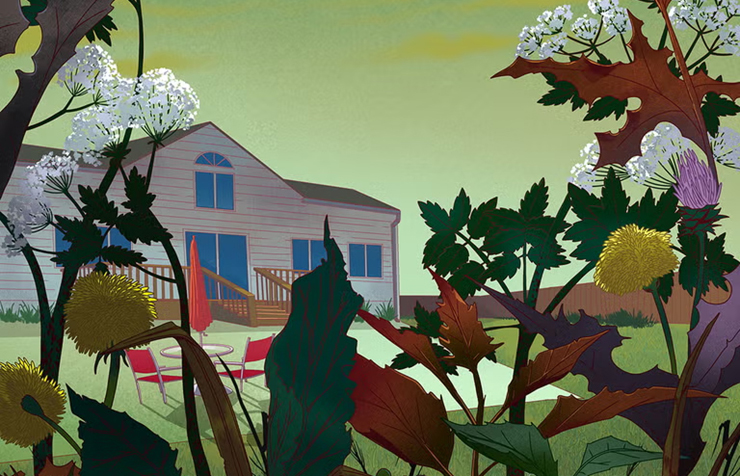
A Tragedy in Three Segments
Segment One: The Ascent
No one saw when the rot first entered. It came not with a bang, but with a honeyed whisper.
Cehrna arrived at the Institute on a humid Monday morning, clutching a letter of recommendation from the Deputy Speaker himself. She was not a woman who commanded attention—her skin was the deep brown of fertile earth, her features ordinary, her sarees always a season out of fashion. But her voice... her voice was liquid gold, poured into every greeting, every inquiry, every casual conversation.
"Sir, you look so worried. Let me bring you tea."
"Madam, your saree is beautiful. Where did you find it?"
"Dear student, you seem troubled. Come, talk to me."She was a mother of three daughters, and she wore this fact like a sacred amulet. "A mother understands," she would say, placing a warm hand on a junior colleague's shoulder. "A mother never judges." The words were balm to lonely hearts, to overworked staff, to students far from home.
But beneath the gentle smiles, beneath the solicitous words, something else lived. A cold, precise ambition that ticked like a metronome, counting the seconds until she could climb higher.
Cehrna's philosophy was simple: the world was a ladder, and she would climb it. Hands would grasp at her ankles? She would step on them. Faces would look up at her? She would step on them too.
Her first rung had been her former university, where she had cultivated a relationship with her arrogant boss—a man whose loyalty, she often whispered knowingly, belonged to "Allahar Dal-er jafik." The phrase suggested a blind, fierce allegiance to the religious right, and the mere whisper of it opened doors. Her husband, a minor clerk with a genius for insinuating himself into political circles, was another asset—unremarkable but useful. The real prize, however, was a distant relative, a mid-level functionary in the ruling party. Through this network of shared cigarettes and whispered promises, she had been introduced to the Deputy Speaker. And the Deputy Speaker had given her the Institute.
For the first year, Cehrna played her role perfectly. She attended every class, her nose buried in books she rarely read. She stayed late, organizing files, cleaning shelves, performing dedication. She sent handwritten notes to senior colleagues on their birthdays. She remembered the names of every peon, every driver, every cleaner.
"She is so down to earth," they said.
"A mother of three, and still so committed," they said.
"If only all teachers were like Cehrna," they said.They did not see her watching. Always watching. Learning who hated whom, who owed whom, who feared whom. She catalogued every weakness, every secret, every whispered confidence. She stored them away like a squirrel hoarding nuts for winter.
Then the Deputy Speaker died.
Cehrna received the news in the staff room. Her face crumpled, tears streaming down her cheeks. "He was like a father to me," she sobbed, and her colleagues gathered around, murmuring sympathy. But even as she wept, her mind was racing, calculating, searching for the next rung.
It came in the form of an apartment. She had moved into a new complex, and her neighbour was Moushumi Rahman—Member of Parliament, iron-haired, iron-willed, famous for her honesty and her sharp tongue. To others, Moushumi was intimidating. To Cehrna, she was an opportunity.
Within a month, Cehrna had become Moushumi's shadow. She ran errands, listened to grievances, echoed opinions with such perfect mimicry that Moushumi began to see a reflection of herself. "That Cehrna," she told colleagues, "is a sincere soul. A solid woman. We need more like her."
Through Moushumi's recommendation, Cehrna found her way to the Institute's Chairman. At a small gathering, she sang—a haunting folk melody about a river that never returns to its source. The Chairman, a man who loved Bengali culture, was enchanted. He saw a woman of depth, of feeling, of dedication. He did not see the viper.
Segment Two: The Reign Professor Khan had been Cehrna's teacher fifteen years ago. He remembered her as a shy, hardworking student who stayed after class to ask questions, who brought him sweets during Eid, who called him "Sir" with genuine reverence. When she joined the Institute, he had wept with joy.
"Allah has blessed me," he told his wife. "My little sister has come back to me."
He was Head of Department, a gentle soul beloved by staff and students alike. His integrity was unquestioned, his dedication absolute. He was also, Cehrna calculated, the only thing standing between her and the department chair.
The whisper campaign began subtly.
"Sir seems so stressed lately," she confided to a junior lecturer. "His temper... I'm worried about him."
"I heard he said something inappropriate to a female student," she murmured to an administrator. "Of course, I'm sure it was a misunderstanding."
The most absurd accusation came later: that Professor Khan, years ago, had set a small fire in the university building to make himself look like a hero. The lie was so bizarre, so baseless, that its very audacity made people wonder. Could there be a grain of truth? Why would anyone invent something so specific?
When Professor Khan finally confronted her, his eyes wet with hurt, she looked at him with tender pity. "Sir," she said softly, "I only want what's best for the department. You're just... tired. Maybe it's time to rest."
He retired six months later, broken and bewildered. Cehrna sent him a beautiful bouquet on his last day.
Her accomplice in the office was Sharmin, a lady clerk whose unhappy marriage had curdled into bitterness. To Sharmin, Cehrna revealed her true self. The honeyed voice dropped its sweetness, replaced by a vulgar, conspiratorial whisper. Together, they dissected their colleagues with coarse cruelty.
"See how she walks, like a preening hen?" Cehrna would say of another female teacher, her face twisted with ugly glee. "Thinks she's better than us because her husband is a doctor."
"And that one," Sharmin would add, "always talking about her PhD. Who cares? She can't even file properly."
In these private moments, Cehrna became the woman of the streets—the vulgar, scheming creature she so carefully hid from the world.
The political landscape shifted. The ruling party fell. The Allahar Dal, once on the fringes, became kingmakers. Cehrna watched the tectonic plates move with a survivor's calculating eye. The morning the news broke, she was on her phone, dialing a number she had kept for years.
Her old university boss, the arrogant Allahar Dal man, was suddenly powerful again.
Yet she did not abandon the Chairman. Not yet. She went to him, her face etched with concern. "Sir, these are dangerous times. Your connection to Moushumi madam... it puts you at risk. But I have friends on the other side. Let me be your bridge. Let me protect you."
The Chairman, a decent man lost in treacherous waters, grasped at her offer like a drowning man clutching driftwood.
Now Cehrna held two ropes: one tied to the Chairman, one tied to the Allahar Dal. She began to pull gently, creating friction, fostering mistrust. To the Chairman: "They are demanding too much. They want control of admissions." To the Allahar Dal man: "The Chairman is resisting. He needs to understand who holds power now."
She made herself indispensable, the sole axis on which the Institute's fate turned.
Her methods grew bolder. She, who had abandoned her own PhD after failing her comprehensive exams, loudly dismissed others' doctorates. "Foreign degrees from diploma mills," she sniffed. "They buy those online." She had never been abroad, yet she spoke with authority on the "laziness" of foreign-educated professors.
She turned students against teachers she disliked, painting them as elitist, incompetent, hostile to student interests. "Under my finger," she boasted to Sharmin, "everyone will dance."
Her teaching was a performance. She would enter the classroom not to educate but to entertain—chatting about films, gossiping about celebrities, making grandiose promises. "You students are my power," she would declare. "Do you know how many high-profile people I know? Engineers, doctors, even a minister! I can bring twenty-five crore taka to this Institute with a single phone call!"
The students, young and impressionable, would clap. They did not know that this woman could not design a syllabus, could not grade a paper fairly, could not explain the simplest concept without consulting notes someone else had prepared.
Cehrna had become queen bee, her authority seemingly absolute. The Institute, once a temple of learning, was now a stage for her machinations. Truth was an inconvenience she had long abolished. Her world was built on whispered lies, fabricated scandals, shifting allegiances.
But a queen bee, for all her power, is blind to the rot within her own hive. And the rot was spreading.
Her husband, that minor clerk she had long dismissed as useful but insignificant, had begun to notice things. Late-night calls. Trips that didn't add up. The Allahar Dal man's number in her phone, saved under a woman's name. One evening, he followed her. He saw her meet the man in a cheap hotel near the bus stand. He watched them through a window, saw things a husband should never see.
He did not confront her. He went home, sat in the dark, and wept. Then he made a phone call of his own—to a journalist he knew from his party connections. A yellow journalist, hungry for scandal.
Segment Three: The Fall The final act began not with politics, but with a student.
Ayesha was final-year, quiet and brilliant, her family poor, her future dependent on a scholarship that had been hers for three years. Then, suddenly, the scholarship was "lost." Administrative error, they said. But Ayesha was smart. She asked questions. She dug through files left carelessly open. She discovered that her scholarship funds had been redirected to a project run by a friend of Cehrna's journalist ally.
With nothing left to lose, Ayesha stood up in the crowded student common room. She did not shout. She did not weep. She simply spoke.
"Who is Cehrna?" she asked. "Is she our teacher? When did she last teach a class? Is she an administrator? What has she ever built? She tells us she can bring twenty-five crore, but our library hasn't had a new book in two years. She tells us she protects us, but she uses us as pawns. She tells us she is a mother, a sincere soul, but she is a liar."
The room fell silent.
"She is a woman who has drunk a cup of poison," Ayesha continued, "and wants us all to drink from the same cup. But I will not drink. And neither should you."
The speech spread like wildfire through the Institute. Students began to ask questions—real questions, not the rehearsed ones Cehrna had taught them to ask. Junior staff, tired of Sharmin's sneering, began to talk. A few brave teachers, long cowed by Cehrna's influence, found their voices.
The Chairman, finally seeing the chasm Cehrna had dug between him and everyone else, began to pull back. But it was too late. The damage was done.
The yellow journalist, the one Cehrna had cultivated so carefully, published his story. But it was not the story she expected. It was about her—her affair with the Allahar Dal man, her manipulation of the Chairman, her theft of Ayesha's scholarship. Her husband had provided photographs, documents, recordings.
The Institute's governing body, spurred by student protests and public scandal, called a special meeting. Cehrna was not invited. They reviewed the evidence: falsified records, intimidation of staff, lies about Professor Khan, misappropriation of funds, witness accounts of her vulgarity and manipulation. The mosaic of her life's work painted a portrait of corruption so complete that even her strongest allies looked away.
The Allahar Dal man, facing his own scandal, denied everything. "I barely knew her," he told reporters. "She pursued me. I was weak. I am ashamed."
Moushumi, the iron lady of parliament, issued a terse statement: "I am shocked and saddened. I believed in her. I was wrong."
Sharmin, offered immunity in exchange for testimony, talked freely. She described Cehrna's private words, her schemes, her contempt for everyone she pretended to love.
A week later, Cehrna was summoned to the main auditorium. The same hall where she had sung for the Chairman, where students had clapped for her promises, was now filled with silent, staring faces. The new Chief of the Institute—Professor Khan, called out of retirement to heal the wounds—sat on the stage.
He looked at her, this woman he had once loved like a sister, and his eyes held no anger. Only sorrow. Only grief.
"Cehrna," he said quietly, "do you remember when you were my student? You stayed after class once, crying because you had failed an exam. I told you then that failure is not the end—that what matters is what we learn from it. I wonder what you have learned since."
She said nothing.
He continued, his voice gentle but clear. "The ancient Athenians gave Socrates a choice: renounce his teachings, or drink the hemlock. He chose the hemlock because he could not betray the truth. You, Cehrna, have spent years betraying truth. You have corrupted this Institute, turned colleagues against each other, stolen from students, poisoned everything you touched."
He gestured to a small table. On it sat a cup of water, clear and pure.
"I offer you the same choice Socrates had, but with mercy. Drink this water, and pledge before this assembly to renounce your lies, your manipulation, your cruelty. Return to being a simple teacher. No power, no position, no influence. Just a teacher. Or..."
He paused, looking at her with infinite sadness.
"Or take the poison you have brewed for others. Leave this Institute forever. But know this: the hemlock is already inside you. It has been for years. If you leave, you take it with you, and it will destroy you wherever you go."
Cehrna looked at the cup. She looked at the sea of faces—students she had promised the world, colleagues she had betrayed, teachers she had slandered. She saw Professor Khan, his face unreadable. She saw Sharmin, small and afraid. She saw Ayesha, standing in the back, her eyes hard.
She looked for an ally. A friendly face. A single person whose gaze held warmth.
There was none.
Her honeyed words, her sweet songs, her grand promises—they evaporated in the silent, judgmental air. The poison hemlock she had so carefully brewed was not in the cup on the table. It was in her. It was the air she breathed. To renounce her ways would be to cease existing. She had spent so long becoming the mask that there was nothing left underneath.
But to leave—to walk out those doors with nothing—that was another kind of death.
Slowly, terribly, Cehrna began to laugh. A dry, hollow sound that echoed off the auditorium walls. "You think this is justice?" she whispered. "You think you have won?"
She walked to the table. She picked up the cup of water. For a moment, her hand trembled. The audience held its breath.
Then she threw the cup to the ground. Water splashed across the stage, across her feet.
"I will not drink your water," she said. "And I will not sign your letter. I will walk out of here with nothing, because nothing is all any of you deserve from me."
She turned and walked toward the heavy doors. Halfway there, she stopped. She looked back at Professor Khan, at the man she had destroyed, and for one fleeting second, something flickered in her eyes. Regret? Recognition? Grief for the girl she had once been?
Then it was gone. She pushed open the doors and walked out into the blinding afternoon sun.
Three days later, a cleaner found her in a cheap hotel room near the bus stand. She had hanged herself with her own saree. On the bedside table, there was a single photograph—her three daughters, smiling at the camera, years ago before everything.
No note. No explanation. Just the photograph, and the silence.
The Institute held a memorial. Not for Cehrna—for the daughters she had left behind. Professor Khan spoke, his voice breaking. "She was my student once," he said. "She was bright and hungry and full of dreams. I don't know when she lost herself. I don't know when the poison entered her. But I know this: we failed her too. We saw the mask and called it a face. We heard the lies and called them truth. We let ambition flourish while integrity withered."
The students lowered their heads. The teachers wept. The heavy doors of the auditorium stood open, letting in the afternoon light.
And somewhere, in the cheap hotel room, in the silence she had chosen, Cehrna's hemlock had finally bloomed.
The most dangerous poison is not the one you drink—it is the one you become. And the tragedy is not that Cehrna died. The tragedy is that somewhere inside her, beneath the layers of lies and ambition, there had once been a girl who stayed after class to ask questions, who brought sweets to her teacher on Eid, who believed that education could save her.
That girl died long before the woman hanged herself. And no one—not even Cehrna herself—had noticed the moment of her passing.
The Institute stands still, its walls witness to another generation of students. But those who remember speak of Cehrna in whispers, a cautionary tale, a ghost who haunts the corridors. They say that sometimes, late at night, you can hear a woman singing—a haunting folk melody about a river that never returns to its source.
And those who know the story cross themselves and hurry away, because they understand: the river never returns. The girl never comes back. And the hemlock, once bloomed, seeds itself in the soil, waiting for the next season, the next ambitious heart, the next honeyed voice that promises everything and delivers only poison.
The short story is written by litterateur Muhammad Mahboob Ali, who is a Professor of a private university, novelist and economist. Email: [email protected]
 ঢাকা টাইমস অনলাইন এর সর্বশেষ খবর পেতে Google News ফিডটি ফলো করুন