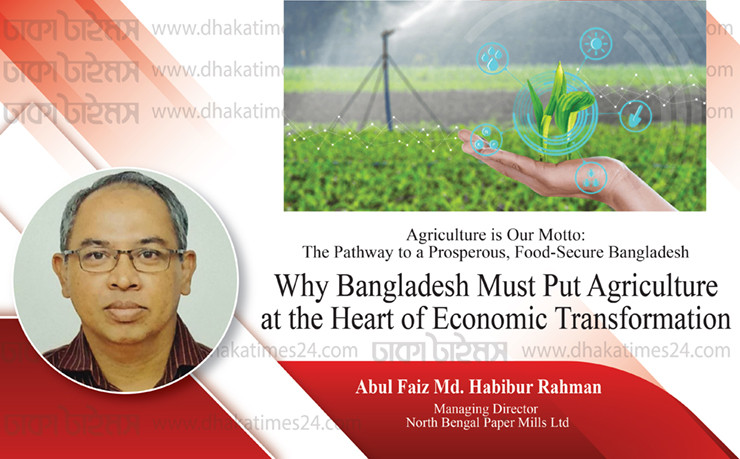
Agriculture is our motto: The Pathway to a Prosperous, Food-Secure Bangladesh
Why Bangladesh Must Put Agriculture at the Heart of Economic Transformation

Introduction: Agriculture Is More Than an Economic Sector
Agriculture is the foundation of Bangladesh's economy, food security, rural employment and social stability. From the fertile plains of the Ganges–Brahmaputra delta to the country's expanding fisheries, livestock farms and horticultural enterprises, agriculture sustains millions of livelihoods and supplies essential raw materials to numerous industries.
As Bangladesh aspires to become a more prosperous, industrialised and technologically advanced nation, agriculture must remain a strategic national priority. Economic transformation cannot be sustainable without ensuring food security, improving farmers' incomes, strengthening rural markets and protecting agricultural resources against climate change.
Our national commitment should therefore be clear: "Agriculture Is Our Motto, Food Security Is Our Mission, and Farmers' Prosperity Is Our Vision."
The challenge is no longer simply to produce more food. It is to build a modern, profitable, climate-resilient and technology-driven agricultural economy that contributes to national GDP, generates employment and improves the quality of life of rural communities.
1. Agriculture's Contribution to Bangladesh's GDP: The Last Five Fiscal Years
Agriculture's contribution to Bangladesh'seconomy can be assessed through its nominal GDP value, share of total GDP and real growth rate.
According to published Bangladesh Bureau of Statistics (BBS) data reported by Bangladesh Bank, agriculture's nominal GDP value increased substantially over the past five fiscal years. However, the sector's share of national GDP has generally declined as industry and services have expanded.
Table 1: Agriculture's Nominal GDP, 2020–21 to 2024–25
Fiscal year
Agricultural GDP (Tk crore)
Approximate share of GDP (%)
2020–21
410,700
12.09
2021–22
445,50011.66
2022–23
494,200
11.30
2023–24
558,500
11.19
2024–25
626,800
10.94
Sources: BBS national accounts data and Bangladesh Bank's Annual Report 2024–2025. The nominal GDP amounts are rounded. The latest reported sectoral shares reflect subsequent statistical revisions, so the figures should be interpreted in the context of changes to national accounting estimates.
The figures reveal two important developments.
First, the nominal value of agricultural outputincreased from approximately Tk 4.11 lakh crore in FY2020–21 to Tk 6.27 lakh crore in FY2024–25. This represents substantial growth in the sector's monetary value.
Second, agriculture's share of total GDP declined. This does not necessarily mean that agricultural production fell. The share can decrease when other sectors grow faster, while inflation and changes in agricultural input and output prices can increase nominal GDP without equivalent increases in physical production.
The appropriate policy response is therefore not merely to increase agricultural output, but to improve productivity, reduce production costs, increase value addition and ensure that farmers receive a fair share of the value generated throughout the supply chain.
2. Why Agriculture Must Remain a NationalPriority
Bangladesh's agricultural sector extends far beyond the cultivation of rice and other staple crops. It includes fisheries, livestock, poultry, horticulture, forestry and a growing range of agricultural services.
These activities support household nutrition, employment, domestic industries and export opportunities.
Food security and price stability
Food security is a fundamental component of national security. Disruptions caused by floods, droughts, excessive rainfall, pest attacks or international commodity-price fluctuations can affect food availability and household purchasing power.
A resilient agricultural system can help stabilise domestic food supplies, reduce vulnerability to external shocks and protect low-income households.Employment and rural development
Agriculture supports millions of people directly and indirectly. Farmers, agricultural labourers, transport operators, traders, millers, food processors and retailers all depend on the sector.
Higher agricultural productivity, combined with profitable rural enterprises, can improve household incomes and reduce distress migration.
Industrial development
Agriculture provides raw materials for food processing, textiles, jute products, leather-related industries, pharmaceuticals and other manufacturing activities.
Stronger links between farms and factories can reduce post-harvest losses, expand domestic production and create new opportunities for small and medium-sized enterprises.Foreign-exchange savings and export potential
Greater domestic production of selected agricultural commodities can reduce import dependence where Bangladesh has a competitive production advantage.
At the same time, processed foods, vegetables, fruits, spices, fisheries products and other agricultural goods offer opportunities to expand exports, subject to international quality, food-safety and traceability requirements.
3. The Productivity Challenge: From Traditional Farming to Smart Agriculture
Despite significant achievements in food production, Bangladesh faces persistent agricultural challenges. These include fragmented landholdings, rising input costs, limited mechanisation in some farming operations, inadequate storage facilities,inefficient marketing systems and exposure to climate-related disasters.
To overcome these constraints, agricultural policy must move towards a productivity-based development model.
Mechanisation and modern technology
Small and medium-sized farmers should receive better access to affordable machinery, including power tillers, seeders, transplanters, harvesters, threshers and modern irrigation equipment.
Cooperative ownership, machinery-rental centres and private service providers can make mechanisation more accessible without requiring every farmer to purchase expensive equipment.
Precision agriculture, satellite-based monitoring, weather forecasting and digital advisory services can further improve the efficiency of fertiliser, pesticide and water use.Research and improved seed varieties
Investment in agricultural research should focus on high-yielding, climate-resilient and disease-resistant crop varieties.
Particular attention should be given to salinity-tolerant crops for coastal districts, flood-tolerant rice varieties for flood-prone regions and drought-resistant crops for areas vulnerable to water shortages.
Improved seeds must be accompanied by reliable extension services so that farmers can apply suitable cultivation practices.
Sustainable soil and water management
Long-term agricultural productivity depends on soil fertility, water availability and the protection of natural resources.
Balanced fertiliser application, soil testing, organic matter management, efficient irrigation and integrated pest management should become standard components ofmodern farming.
Bangladesh must also strengthen the monitoring of agricultural inputs to ensure quality and prevent the circulation of counterfeit or substandard products.
4. Agricultural Inputs: A Strategic Link Between Industry and Food Security
Bangladesh's fertiliser industry has a particularly important role in agricultural development.
Urea, triple superphosphate (TSP), diammonium phosphate (DAP) and muriate of potash (MOP) support crop production when used in accordance with soil requirements and recommended application rates.
The availability, quality and affordability of these inputs directly affect farmers' production costs and agricultural productivity.
For Bangladesh, a coordinated strategyinvolving the Ministry of Agriculture, the Ministry of Industries, the Bangladesh Chemical Industries Corporation (BCIC), research institutions and private-sector distributors is essential.
The strategy should include:
Reliable fertiliser production: Improve the operational efficiency, energy management, maintenance and environmental performance of domestic fertiliser factories.
Import planning: Forecast domestic demand accurately and arrange imports sufficiently in advance to reduce supply disruptions and emergency procurement.
Efficient distribution: Strengthen district-level and upazila-level monitoring to ensure fertiliser reaches farmers at the appropriate time.
Balanced fertilisation: Promote soil testing and crop-specific recommendations toprevent excessive or unbalanced application.
Energy efficiency: Reduce natural-gas consumption per unit of output and explore economically viable opportunities to use renewable electricity in appropriate industrial operations.
Transparency and accountability: Improve inventory management, procurement oversight and digital tracking throughout the fertiliser supply chain.
Domestic production and imports should be managed as complementary components of a national food-security strategy.
The objective should be to ensure that farmers receive the right fertiliser, in the right quantity, at the right price and at the right time.
5. Fisheries, Livestock and Horticulture: Diversifying Agricultural Growth
A modern agricultural economy cannotdepend exclusively on cereal production.
Bangladesh has significant opportunities to expand high-value agricultural activities, particularly fisheries, poultry, dairy, livestock, fruit cultivation, vegetables, flowers and spices.
Fisheries and aquaculture can contribute to nutrition, employment and export earnings. However, development must be accompanied by improved water quality, disease management, feed quality and responsible harvesting practices.
Livestock and dairy production can be strengthened through better veterinary services, improved animal nutrition, disease prevention and modern processing facilities.
Horticulture deserves special attention because fruits, vegetables and flowers can generate higher returns per unit of land under suitable conditions.Investment in cold storage, refrigerated transport, grading, packaging and food processing can reduce post-harvest losses and help farmers obtain better prices.
Bangladesh should also encourage agro-processing enterprises in rural areas. These businesses can transform agricultural commodities into higher-value products, expand non-farm employment and strengthen connections between farmers and domestic and international markets.
6. Climate Change: The Greatest Long-Term Agricultural Risk
Bangladesh is particularly vulnerable to climate-related hazards because of its geography, river systems, coastal exposure and population density.
Floods, cyclones, salinity intrusion, droughts, irregular rainfall and rising temperatures candamage crops, livestock, fisheries and rural infrastructure.
Climate resilience must therefore be integrated into every stage of agricultural planning.
Priority measures include:
Developing climate-resilient crop varieties.
Expanding water-efficient irrigation and rainwater management.
Strengthening embankments and drainage systems where appropriate.
Improving agricultural weather forecasting and early-warning services.
Promoting crop diversification and agroforestry.
Expanding agricultural insurance and risk-management mechanisms.
Restoring wetlands and protecting ecosystems that support agricultural production.Climate-smart agriculture should be viewed not as an additional expense, but as an investment in the long-term stability of Bangladesh's economy.
7. Digital Agriculture and Artificial Intelligence
The integration of digital technology and artificial intelligence into agriculture could substantially improve decision-making and resource efficiency.
Mobile-based advisory services can provide farmers with information about weather, crop diseases, market prices and recommended cultivation practices.
AI-supported systems may help identify plant diseases from photographs, estimate crop yields, forecast pest outbreaks and improve irrigation scheduling.
Digital marketplaces can connect farmers with buyers and reduce information gapsbetween producers and consumers.
However, technological development must remain inclusive. Smallholders need affordable internet access, reliable local-language information, practical training and appropriate financial services.
The government, universities, agricultural research organisations, technology companies and financial institutions should work together to ensure that digital agriculture delivers measurable benefits to ordinary farmers.
8. Agricultural Finance and Fair Prices for Farmers
One of the most important barriers to agricultural development is the gap between the cost of production and the price received by farmers.
Farmers may face high input costs, expensivecredit, limited storage facilities and the risk of being forced to sell produce immediately after harvest.
A comprehensive agricultural finance and marketing policy should therefore include:
Affordable seasonal agricultural credit.
Better access to crop insurance and emergency financing.
Modern warehouses and cold-storage facilities.
Digital platforms for agricultural marketing.
Transparent market-price information.
Stronger farmer cooperatives and producer organisations.
Contract farming arrangements with appropriate safeguards.
Improved access to domestic and export markets.
Government procurement, where appropriate, should be designed transparently andimplemented in ways that benefit genuine producers.
The ultimate goal should be to increase farmers' net income, rather than measuring success only by the volume of crops produced.
9. A Five-Year Agricultural Transformation Agenda
Bangladesh should adopt a coordinated five-year agricultural transformation programme, aligned with national development priorities and available public resources.
Priority area
Proposed action
Expected outcome
Productivity
Expand mechanisation, improved seeds and extension services
Higher yields and lower production costs
Food securityStrengthen crop diversification and strategic food reserves
Greater resilience to supply shocks
Agricultural inputs
Improve fertiliser planning, production and distribution
More reliable and efficient input supply
Water management
Promote efficient irrigation and sustainable groundwater use
Reduced resource wastage
Climate resilience
Invest in climate-smart farming and disaster preparedness
Lower agricultural losses
Agro-processing
Develop storage, cold chains and rural processing facilities
Higher value addition and lower post-harvest lossesDigital agriculture
Expand AI-supported advisory and market information services
Better decisions and improved market access
Agricultural finance
Improve access to credit, insurance and investment
Stronger farm profitability
Exports
Improve food safety, packaging and international certification
Greater access to export markets
Governance
Establish measurable targets and transparent monitoring
Better public investment outcomes
These are proposed policy priorities, not forecasts of guaranteed results. Their effectiveness will depend on implementation capacity, financing, institutional coordinationand measurable performance indicators.
10. Measuring Success: Beyond Agriculture's Share of GDP
A declining agricultural share of GDP does not automatically indicate a decline in agricultural development.
As countries become wealthier, industry and services often account for a growing proportion of economic output. Nevertheless, agriculture remains strategically important because it supplies food, employment, industrial raw materials and essential ecosystem services.
Bangladesh should therefore assess agricultural performance using several indicators:
Real agricultural GDP growth.
Crop yields and total factor productivity.
Farmers' real income and production costs.Food prices and household food security.
Post-harvest losses.
Agricultural exports and agro-processing value added.
Water-use efficiency and soil health.
Climate-related agricultural losses.
Rural employment and poverty reduction.
The availability and affordability of essential agricultural inputs.
A balanced performance framework would provide a more accurate picture of progress than nominal GDP figures alone.
The latest BBS final estimates also underline the importance of productivity improvement. Agriculture grew by 2.42% in FY2024–25, compared with 3.30% in FY2023–24, according to reporting on the revised national accounts figures published in February 2026.
This slowdown reinforces the need for stronger agricultural investment, climateresilience, technology adoption and better market access.
Conclusion: Agriculture Must Lead the Journey Towards Prosperity
Bangladesh has achieved substantial progress in agricultural development, food production and rural transformation. However, future challenges require a more integrated approach that connects farming with industry, technology, finance, environmental protection and international trade.
The country's agricultural future must be built on productivity, profitability, sustainability and resilience.
Public investment should prioritise agricultural research, rural infrastructure, efficient water management, modern storage, mechanisation and digital services. Private investment should be encouraged in agro-processing, cold chains, quality seeds,agricultural machinery and export-oriented production.
At the same time, farmers must remain at the centre of national agricultural policy. Their access to fair prices, affordable inputs, reliable markets and modern technology will determine whether agricultural growth translates into improved living standards.
Bangladesh must recognise that agriculture is not simply a traditional sector awaiting replacement by industrialisation. Rather, a productive agricultural economy is an essential partner in industrial development and a foundation for sustainable national prosperity.
The time has come to transform our agricultural potential into measurable economic progress through strategic planning, modern technology, institutional coordination and farmer-centred governance.Our guiding principle should be:
“Agriculture Is Our Motto, Food Security Is Our Mission, Farmers' Prosperity Is Our Vision, and Sustainable National Development Is Our Destination.”
If Bangladesh can translate this commitment into effective policies and practical action, agriculture will continue to play a decisive role in building a prosperous, resilient and food-secure nation.
Writer: Managing Director, North Bengal Paper Mills Limited, [email protected]
(Dhakatimes/8 November/RZ)
 ঢাকা টাইমস অনলাইন এর সর্বশেষ খবর পেতে Google News ফিডটি ফলো করুন