BAC Accreditation Framework: A Contemporary Overview

Higher education is the cornerstone of Bangladesh’s transition from a labor-dependent economy to a high-value, knowledge-based society. At the heart of this transformation is the Bangladesh Accreditation Council (BAC). Established under the landmark BAC Act of 2017, the Council is the premier body driving quality assurance across the nation's higher education sector. By implementing the Bangladesh National Qualifications Framework (BNQF), the BAC accredits Higher Education Institutions (HEIs) and their academic programs. This ensures that domestic degrees meet international benchmarks, paving the way for global recognition of Bangladeshi graduates. To balance rigorous quality with academic freedom, the Council uses a flexible, multi-tiered accreditation pathway:

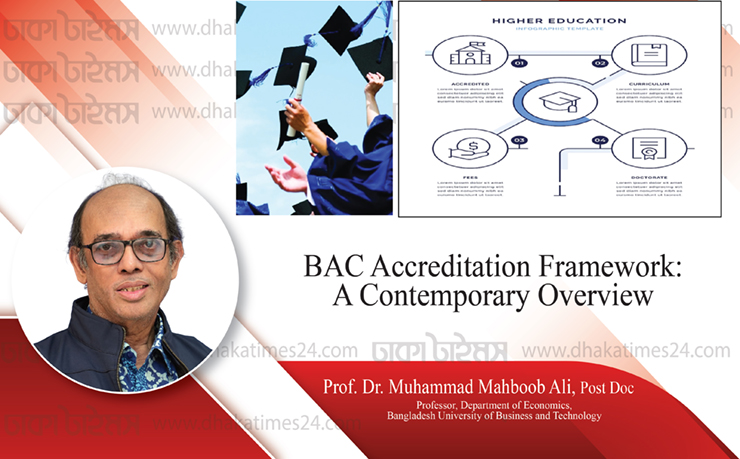
This diagram shows how different key areas connect:
- Accreditation: Reaffirming institutional excellence through programmatic and university-wide evaluations (matching Programmatic and Institutional pathways).
- Curricular Alignment: Keeping course designs, learning outcome cascades, and student expectations aligned with global standards.
- Funding & Resources (UGC): Distributing capital to support high-quality infrastructure, research, and veteran faculty.
- Certification: Awarding final credentials, such as the full 5-year accreditation or transitional options like the Certificate of Confidence.
The contemporary quality assurance ecosystem did not emerge overnight. It stands on the firm foundations built by the Higher Education Quality Enhancement Project (HEQEP), a major collaborative initiative between the Government of Bangladesh and the World Bank.
During this project, the Asian Institute of Technology (AIT) Extension in Thailand played a vital role in capacity building. AIT Extension designed and delivered elite professional training programs for Bangladeshi educators, administrators, and quality assurance experts. Their practical workshops on university management, institutional self-assessment, and student-centered learning empowered academic leaders to establish Institutional Quality Assurance Cells (IQACs) across the country.
Socio-Economic Impact: International collaborations do more than upgrade classrooms—they inject global best practices into local institutions. To sustain this momentum, Bangladesh must actively pursue deeper partnerships with leading global universities. Joint degree programs, shared research repositories, and faculty exchanges keep our academic standards globally aligned, making our workforce highly competitive on the international stage.
The BAC’s accreditation framework is built on Outcome-Based Education (OBE) principles, which shift the focus from what teachers teach to what graduates can actually do. The ten accreditation standards used by the BAC map directly to the BNQF's four core learning outcome domains:
- Fundamental Domain: Subject-specific knowledge and its practical application.
- Social Domain: Essential soft skills including communication, negotiation, teamwork, and community awareness.
- Thinking Domain: Cognitive empowerment through critical thinking, creative problem-solving, and entrepreneurship.
- Personal Domain: Professional ethics, civic responsibility, self-direction, and lifelong learning.
To operationalize these domains, universities utilize a structured educational cascade that links classroom activities directly to high-level graduate competencies:
[ BNQF Learning Outcome Domains]
│
▼
[ Graduate Attributes]
│
▼
[ Program Learning Outcomes]
│
▼
[ Course Learning Outcomes]
│
▼
[ Teaching-Learning-Assessment (TLA)]
To become globally competitive, Bangladesh must move away from rigid, overly centralized administrative habits and adopt the flexible, autonomous principles found in North American higher education systems.
Entry-level academic hiring in Bangladesh relies too heavily on Secondary School Certificate (SSC) and Higher Secondary School Certificate (HSC) grades. To foster a world-class research culture, universities should recruit PhD holders with active publication records directly as Assistant Professors, ignoring secondary school scores entirely. Academic mastery and research potential cannot be predicted by exams taken in a candidate's teenage years.
While Bloom’s Taxonomy is a useful pedagogical tool, its rigid, mechanical application across all disciplines has created a mountain of paperwork. Faculty members waste valuable time fitting creative, hands-on, and industry-ready projects into strict cognitive boxes. Easing this over-reliance gives educators the freedom to run experiential, real-world learning modules.
To retain intellectual capital, we must reconsider rigid retirement ages for senior faculty. The tenure of a professor should depend on their physical and mental fitness to teach, research, and mentor—not an arbitrary age limit. Forcing highly productive, globally recognized scholars into retirement deprives institutions of vital leadership.
A modern, inclusive higher education system must adapt to the diverse realities of its student body. Universities should implement robust support systems for student parents, including on-campus childcare, flexible class schedules, parental leave, and hybrid learning options. This ensures that student parents can complete their degrees without sacrificing family welfare.
The BAC provides four distinct tracks to guide institutions toward high-quality benchmarks:
|
Pathway / Provision |
Core Criteria & Requirements |
Applicability |
|
Program Accreditation |
10 standards, 63 criteria; UGC approval; active IQAC; aligned curriculum; at least one graduated cohort (minimum 2 years prior). |
Individual Bachelor's level programs and above |
|
Institutional Accreditation |
A minimum of 20% of total programs (and at least 3) must be fully BAC-accredited first. |
Entire Higher Education Institution (HEI) |
|
Accreditation by Recognition |
Valid, high-quality accreditation from an aligned, reputable international agency. |
Internationally recognized programs or HEIs |
|
Certificate of Confidence |
Overall EQA score of 60% to 69% (with at least 50% in every individual standard). |
Provisional pathway (strictly valid for 1 year; non-renewable) |
The accreditation process begins with a comprehensive, internal Self-Assessment Report (SAR) evaluating the program's strengths, weaknesses, opportunities, and threats (SWOT). Following submission, the BAC deploys external reviewers and academic auditors for desk reviews and on-site visits.
Accredited programs receive a five-year certificate, maintained via biennial and unannounced audits. Under the BAC Act of 2017, non-compliance can lead to suspension, though institutions retain the right to appeal.By 2027, this framework has driven remarkable progress. Electrical and Electronic Engineering (EEE) departments at prominent universities—including American International University-Bangladesh (AIUB), Daffodil International University (DIU), Premier University, and BUBT—have achieved full programmatic accreditation. Premier University has also secured accreditation for its Business, English, Law, and Economics programs, while major public institutions like Khulna University, Rajshahi University, and BUP are actively preparing for their upcoming reviews.For simplifying Roles: UGC, BAC, and the Ministry of Education reforms to succeed, the government must eliminate overlapping jurisdictions and red tape. Currently, universities face long delays because curricula must go through redundant approval loops across multiple bodies.
The government should establish a single, shared digital portal to coordinate these agencies, dividing responsibilities clearly:

This model shifts the focus of educational regulatory bodies away from repetitive, manual paperwork and toward high-impact national growth. Streamlining academic governance ensures our universities spend less time on administration and more time developing skilled, innovative, and highly employable graduates.
By shifting away from highly centralized, bureaucratic models (such as Malaysia's) and adopting the highly autonomous peer-review models of North America, the government can cut through red tape. Universities to focus less on administrative paperwork and more on delivering world-class education. While the University of Dhaka remains the premier academic institution in Bangladesh, the University of Chittagong must urgently improve its BAC accreditation. Enhancing quality assurance in Chittagong will bridge regional educational gaps, unlocking vital social and economic opportunities while producing highly skilled graduates to fuel southeastern Bangladesh's thriving economy.
To maximize the economic and social returns of higher education, private universities—which educate a major portion of Bangladesh's tertiary students—must change their hiring strategies. They must move away from a heavy reliance on temporary, part-time, or junior lecturers and actively appoint full-time, experienced senior faculty (such as Professors ).
┌─────────────────────────────────────────────────────────────────────────┐
│ SOCIO-ECONOMIC PAYOFFS OF SENIOR FACULTY │
├────────────────────────────────────┬────────────────────────────────────┤
│ ECONOMIC BENEFITS │ SOCIAL BENEFITS │
├────────────────────────────────────┼────────────────────────────────────┤
│ • Senior research yields patents │ • Deep mentorship cultivates │
│ and local industry solutions. │ emotional intelligence & ethics. │
│ • High-value skills attract foreign│ • Strong role models inspire │
│ direct investment (FDI). │ progressive civic leadership. │
│ • Relevant curricula reduce │ • Academic success drives upward │
│ graduate underemployment. │ social mobility for families. │
└────────────────────────────────────┴────────────────────────────────────┘
When private universities invest in full-time senior academic leadership, they do more than pass accreditation audits. They build the intellectual foundation needed to accelerate social mobility, drive national innovation, and secure a prosperous, self-reliant future for Bangladesh. To align with global standards like those in the United States, the age limit for tenured professors in Bangladesh should be removed. Professors should be allowed to serve as long as they remain physically and mentally fit, dedicating their lifelong expertise to the betterment of their students. Furthermore, to retain invaluable academic talent, private universities must establish official positions for supernumerary and emeritus professors. Creating these prestigious roles will not only preserve institutional knowledge but also deeply enrich student engagement, providing young learners with direct access to seasoned mentors, research pioneers, and industry-linked advocates who can guide their career success.
Writer: Professor, Department of Economics, Bangladesh University of Business and Technology
(Dhakatimes/18july/RZ)
 ঢাকা টাইমস অনলাইন এর সর্বশেষ খবর পেতে Google News ফিডটি ফলো করুন