Palashi Day in National Consciousness: A Historical Warning

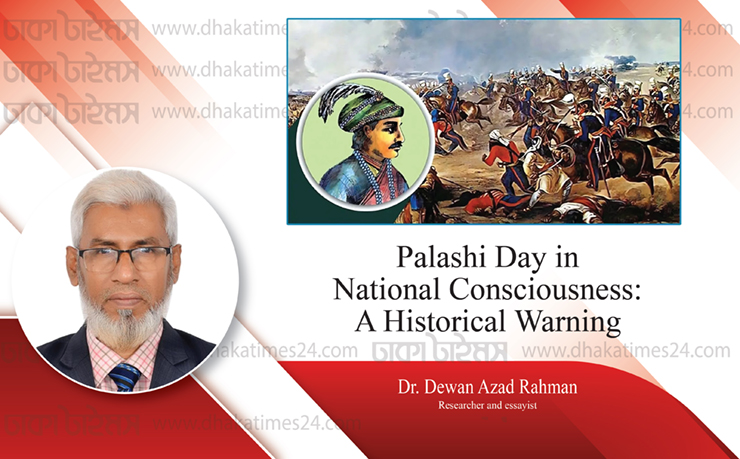
June 23 is a deeply painful day in the history of Bengal. On this day in 1757, the forces of Nawab Siraj ud-Daulah and the army of the English East India Company faced each other at the mango grove of Palashi. The battle did not last long in terms of time, but its consequences changed the fate of Bengal. Palashi is not merely the name of a battlefield; it is a tragic symbol of betrayal, greed for power, political shortsightedness, lack of national unity and foreign conspiracy. For that reason, Palashi Day is not only a day of remembering the past; it is also a day of warning the present and protecting the future.
The field of Palashi still raises difficult questions before us. How did a prosperous land move toward subjugation within such a short time? Why was the Nawab of Bengal defeated despite having wealth, administrative strength and a large army? Why did people from within the house help to break the house itself? When we search for the answers, we realize that the fall of a nation does not happen suddenly. Behind it remain internal weakness, selfishness, crisis of leadership, moral decay and failure to identify the enemy's strategy in time.
No foreign power can easily defeat a nation if that nation possesses unity, honesty and firm leadership. The greatest tragedy of Palashi is that the road to Bengal's fall was prepared from inside Bengal itself. Around the Nawab were many influential people who placed personal interest above the freedom of the country. Mir Jafar, Jagat Seth, Rai Durlabh and others entered into secret understandings with the English. They thought that removing the Nawab would increase their own power and status. They forgot that power standing on the mercy of a foreign force is never independent power; it is another name for servitude.
On the battlefield of Palashi, the Nawab's army was much larger in number than that of the English. Yet history repeatedly proves that war does not depend only on the number of soldiers or the strength of weapons. It depends on morale, leadership, discipline, loyalty and the purity of purpose. In the Nawab's camp there were suspicion, division and hidden conspiracy. Mir Jafar and the troops loyal to him remained inactive during the battle. On the other hand, loyal heroes such as Mir Madan and Mohanlal fought with courage. But when the bravery of a few stands against the betrayal of many, the road to victory becomes extremely difficult.
When leadership inside a country is divided, when administration becomes weak, when influential groups are blinded by self-interest and when the greater interest of the people is ignored, an external enemy easily finds opportunity. Before Palashi, unity was absent in the court of Bengal. Some were dissatisfied with the Nawab, some were attracted by the hope of power, some by money and some by the imagined future strength of the English. This internal fracture created the foundation of defeat. Even today, whether in a state, society or institution, internal division opens the door to outside damage.
Betrayal can change the course of a nation's history. The name of Mir Jafar is not merely the name of one individual; it represents a mentality. He sat on the throne for a short time, but in the memory of the nation he remained a figure of disgrace. His betrayal was apparently against the Nawab, but its real blow fell upon the freedom, dignity and future of Bengal. History teaches us that power is temporary, but character is permanent. Position does not make a person great; a person becomes great through morality, courage and patriotism.
It is essential to remain alert to the diplomatic and strategic moves of foreign powers. The English did not win at Palashi only with cannons and guns. They won by using temptation, money, conspiracy, division and psychological tactics. They knew whom to buy with money, whom to tempt with power, whom to frighten and whom to use in order to isolate the Nawab. In today's world, the form of colonial rule has changed, but the methods of influence still exist through economy, technology, information flow, culture and diplomacy. Friendship and cooperation are necessary, but vigilance in protecting national interest is even more necessary.
Economic independence is the foundation of political independence. Before Palashi, Bengal was one of the richest regions of the subcontinent. Agriculture, textiles, silk, muslin, river trade and revenue made Bengal prosperous. This wealth increased the greed of the English Company. At first they sought commercial privileges; later they took advantage of duty-free trade; then they extended their influence over revenue and administration. After Palashi, the way was opened for the plunder of Bengal's resources. If a nation becomes economically dependent, its freedom to make political decisions also becomes weak.
Far-sighted leadership is indispensable for a nation. Siraj ud-Daulah understood the danger posed by the English, but he could not effectively control the conspirators around him. He had courage, but his political experience was limited. A leader needs more than emotion or bravery. He needs wisdom, patience, the ability to understand people, the capacity to choose the right advisers, the skill to build a disciplined administration and the firmness to make correct decisions in times of crisis. Palashi reminds us that when leadership is weak, even a strong army becomes weak.
Justice and accountability inside the state are also essential. In the context of Palashi, there were various forms of dissatisfaction among the court, the army, the business groups and the elite. The English used that dissatisfaction for their own purpose. If injustice, inequality, corruption and distrust increase in a state, internal cracks appear before any external attack. Therefore, a strong state requires not only external security but also internal justice, good governance, public trust and institutional honesty.
Patriotism must be proved through action, not merely through words. On the battlefield of Palashi, many claimed to be on the side of the Nawab, but in the moment of crisis they remained silent or inactive. History remembers as true patriots those who made their position clear in danger. The bravery of Mir Madan and Mohanlal is therefore still mentioned with respect. Patriotism does not mean emotional speeches alone. It means performing one's duty honestly, standing against injustice, protecting national resources and placing the interest of the country above personal gain in times of crisis.
The lesson of Palashi is important for families, society and educational institutions as well. This history should be presented to children and young people in such a way that they do not merely memorize the names of Siraj ud-Daulah, Mir Jafar and Clive. They should understand the importance of patriotism, honesty, unity and leadership. If the study of history is not connected with life, it remains confined to textbook pages. The new generation must learn that freedom is not an accidental achievement. It requires self-respect, struggle, honesty and the collective consciousness of the people.
Bangladesh is now an independent state. Yet the long journey from Palashi in 1757 to the Liberation War of 1971 shows us how deep the pain of losing freedom is and how great the price of regaining it can be. Palashi is the history of our loss; the Liberation War is the history of our awakening. Palashi warns us, while the Liberation War gives us courage. Together these two chapters teach us that protecting independence is as important as achieving it. Independence is not merely a map; it is economic capacity, cultural dignity, political freedom and a society based on justice.
A nation does not always need to be weakened by foreign armies. Confusion, corruption, division, rumor, debt traps, market dependence and cultural self-forgetfulness can also become powerful weapons. Therefore, we need conscious citizens, honest leadership, strong institutions, quality education, a production-oriented economy and a generation aware of history. National security is not limited to guarding borders. It is built on public trust, administrative honesty, economic stability, an acceptable justice system and a knowledge-based society.
The real significance of Palashi Day lies in self-criticism and self-awakening. Are we giving importance to national unity? Are we creating a social stand against corruption, betrayal and opportunism? Are we teaching true history to the young generation? Are we learning to place national interest above personal interest? Searching for answers to these questions is the true purpose of observing Palashi Day.
The history of Palashi may be dark, but its lessons can be full of light. If we can turn the pain of Palashi into self-criticism, the memory of betrayal into moral awakening and the experience of subjugation into a pledge to protect independence, Palashi Day will truly serve the nation. June 23 is therefore not only a day of mourning for the past; it is a day of commitment to building the future. Let our pledge on Palashi Day be to learn from history, understand the value of freedom, place national interest above all narrow interests and ensure that no new Palashi is ever born again.
Writer: Essayist and Researcher
 ঢাকা টাইমস অনলাইন এর সর্বশেষ খবর পেতে Google News ফিডটি ফলো করুন