Semiconductors: A New Economic Opportunity, A New Prospect for Bangladesh

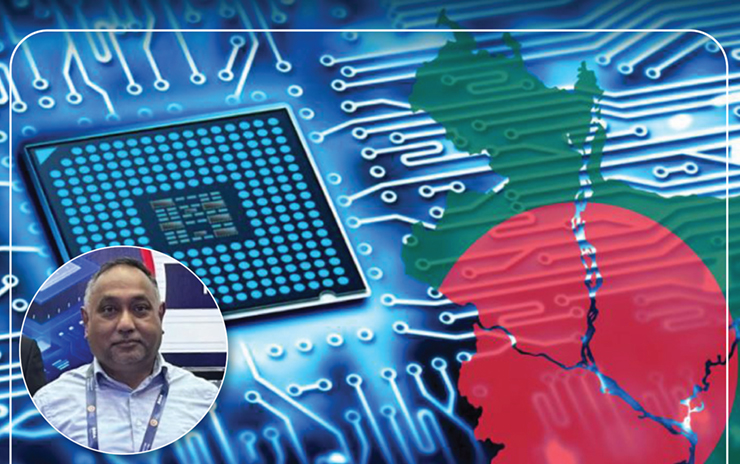
The semiconductor industry is rapidly becoming a crucial part of the global economy. These tiny chips, which are used in almost every sector of today’s technology-driven world, are no longer just a technological component but have also become a key factor in geopolitical power. As global demand for semiconductors continues to rise, Bangladesh could open new doors of opportunity in this sector, according to industry experts.
Semiconductors or chips are the backbone of modern electronic products. They are used in everything from smartphones, computers, automobiles, and medical equipment to artificial intelligence (AI) technologies. Due to Taiwan’s dominance in the global semiconductor market, chips have now become an important part of international politics as well.
Taiwan’s TSMC is currently one of the world’s largest semiconductor manufacturers. The company controls a significant portion of advanced chip production worldwide. During the COVID-19 pandemic, disruptions in TSMC’s production caused major setbacks for automobile, telecommunications, and technology industries across the globe.
The primary material used in semiconductors is silicon, which is mainly obtained from sand. Silicon is used to create transistors, and billions of transistors combined together form an integrated circuit, commonly known as a chip.
Different countries play important roles in the overall chip manufacturing process. Companies in the United States provide chip designs, software, and essential technologies. Japan produces specialized metals and chemical materials required for manufacturing. The Netherlands produces advanced ultraviolet (UV) lithography machines, which are used to manufacture extremely small chips.
Companies that design chips are known as “fabless” companies, while those that manufacture chips are called “foundries.” Taiwan’s TSMC is currently the leading company in the foundry business.
The semiconductor industry is now witnessing a race to develop smaller and more powerful chips. Decades ago, chip technology was measured in micrometers, but today it has advanced to the nanometer scale.
Intel’s first processor, introduced in 1971, contained 2,250 transistors. Today, modern processors contain billions of transistors. Technology companies are demonstrating their capabilities by producing 10-nanometer, 7-nanometer, 5-nanometer, and 3-nanometer chips. Research is also underway to develop 2-nanometer chips.
The diameter of a human hair is around 90,000 nanometers, while the size of modern chips is only a few nanometers. Producing such tiny technologies requires extremely clean environments and highly advanced manufacturing systems.
Once a largely agricultural and low-income country, Taiwan has transformed itself into one of the world’s leading semiconductor powers through long-term planning and investment in technology.
With the establishment of TSMC, Taiwan became a global hub for chip manufacturing. The company’s founder, Morris Chang, used his experience in the US technology sector to build a new industrial foundation in Taiwan.
Although Bangladesh’s participation in the global semiconductor market is still limited, the country has significant potential due to its skilled workforce, relatively low operating costs, and growing interest in technology.
Bangladesh produces a large number of engineering graduates every year, creating an important talent pool for the semiconductor industry. Several local companies have already started working in chip design and technology services.
Semiconductor design company Ulkasemi has started operations in Bangladesh and is providing chip design services to international markets from the country. In addition, Neural Semiconductor has established a VLSI design center in Dhaka.
With increased investment in the technology sector, Bangladesh can move beyond chip design and potentially develop a strong position in semiconductor testing, packaging, and other related services in the future.
Experts believe that success in this sector will require skilled workforce development, increased research activities, stronger collaboration between universities and industries, and long-term government policy support.
The semiconductor industry can diversify Bangladesh’s export sector while creating thousands of high-skilled employment opportunities.
Writer: SVP and Head (DTCO), Senior Fellow, GlobalFoundries, USA
(Dhakatimes/27july/RZ)
 ঢাকা টাইমস অনলাইন এর সর্বশেষ খবর পেতে Google News ফিডটি ফলো করুন