Korean EPZ in Chattogram: A Strategic Model for Bangladesh’s Mixed Economy

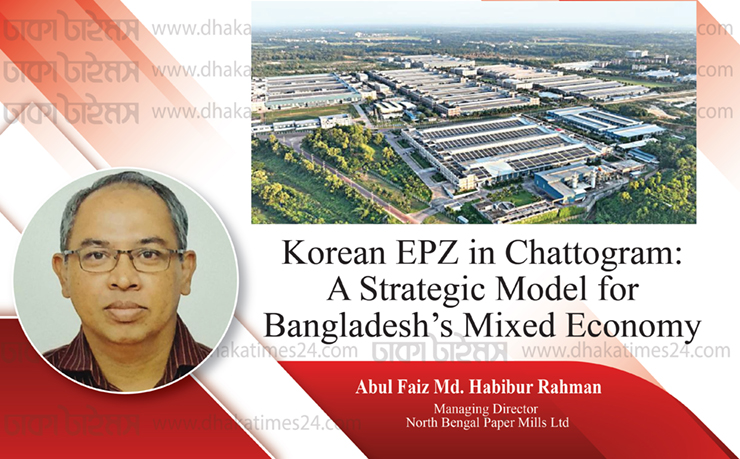
Chattogram— Bangladesh’s economic landscape is entering a period in which sustaining growth will increasingly depend on investment, industrial diversification, productivity and export competitiveness. Against this backdrop, the Korean Export Processing Zone (KEPZ) in Chattogram can be viewed not
merely as an export-oriented industrial enclave, but as a practical example of how public policy, private investment, foreign capital, technology and skilled labour can work together within a mixed-economy framework.
Bangladesh’s five-year GDP picture
Fiscal year
-----------------
Real GDP growth
FY2020-21
6.94%
FY2021-22
7.10%
FY2022-23
5.78%
FY2023-24
4.22%
FY2024-25
3.49%
The figures show a clear slowdown after the strong post-pandemic recovery. BBS’s latest final figure forFY2024-25 is 3.49%, revised down from the earlier provisional estimate of 3.97%. The economy’s nominal size reached about Tk55.15 lakh crore (around US$456 billion) in FY2024-25.
************
Bangladesh GDP growth, FY2020-21 to FY2024-25
Final BBS growth figures show a decline after the post-pandemic recovery.
GDP growth
4.22%
Source: Bangladesh Bureau of Statistics; figures are real GDP growth rates.Why KEPZ matters ********************
The Korean EPZ was established in Anwara, Chattogram, with South Korean investment and has developed as a major export-oriented industrial platform. Its importance lies not only in the factories operating inside the zone but also in the broader economic relationships it can generate—employment, exports, foreign investment, technology, management practices and supplier networks. The model is particularly relevant for Bangladesh because the country
needs to move from dependence on a relatively narrow group of export products toward higher-value and more diversified manufacturing.
The broader Chattogram region possesses a strategic combination of seaport connectivity, industrial infrastructure and access to international markets. Chattogram EPZ itself highlights its proximity to the port as an important advantage for export-oriented investment. �
World Bank Open Data
A mixed-economy model in practice
A modern mixed economy does not necessarily mean choosing between state ownership and private ownership. Rather, it can meanassigning different responsibilities to the public and private sectors.
Government:
policy and regulatory framework;
industrial infrastructure;
energy and transport connectivity;
investment facilitation;
environmental and labour standards;
skills-development institutions.
Private sector:
capital investment;
technology and innovation;
production and management;
international marketing;
productivity improvement.
Foreign investors:
global supply chains;
advanced manufacturingtechnology;
international standards;
access to overseas markets.
Local entrepreneurs:
supporting industries;
component manufacturing;
logistics and services;
SME supplier networks.
This combination can create a stronger industrial ecosystem than an isolated factory or industrial estate.
The urgency of industrial diversification
The latest BBS data provide an important context. In FY2024-25, the industrial sector grew by 3.71%, while agriculture grew by 2.42%,according to the final figures. �
The Daily Ittefaq
At the same time, Bangladesh needs to create more productive employment and increase the domestic value added generated from exports. This makes industrial zones capable of attracting long-term foreign and domestic investment particularly important.
The Korean experience is relevant because Korean manufacturing development has historically been associated with export orientation, technology acquisition, industrial discipline and integration into global production networks. A Bangladesh-Korea industrial partnership cantherefore extend beyond individual factories toward technology, skills and supply-chain development.
From EPZ to industrial ecosystem
The next phase of KEPZ should ideally focus on creating an integrated ecosystem rather than simply increasing factory numbers.
1. Technology transfer:-
-------------------------------------
Foreign investment should increasingly be linked with technology transfer and local capacity development. Joint training programmes between investors, universities and technical institutes could help develop a skilled industrial workforce.2. Local supplier development:-
-------------------------------------------------
Large export factories can generate significant opportunities for Bangladeshi SMEs. Packaging, accessories, engineering services, maintenance, logistics, software and other inputs can increasingly be sourced locally where quality and cost permit.
3. Export diversification
---------------------------------------
The industrial base around Chattogram could gradually expand beyond traditional garments into:
footwear and leather goods;
technical textiles;
electronics and electrical equipment;light engineering;
automobile components;
medical and pharmaceutical products;
outdoor and sports equipment;
renewable-energy equipment.
Such diversification would reduce concentration risk and potentially increase export value per worker.
4. Green manufacturing:-
---------------------------------------
Future industrial investment should increasingly incorporate renewable energy, water recycling, energy efficiency, waste management and low-carbon production.
A green KEPZ could become a demonstration model forenvironmentally responsible industrial development in Bangladesh.
Chattogram as an industrial corridor
KEPZ should also be considered within the wider industrial geography of Chattogram.
The region already contains Chattogram EPZ, Karnaphuli EPZ, KEPZ and the emerging industrial development around Mirsharai. Rather than managing these locations as completely separate entities, Bangladesh could develop a coordinated Chattogram Industrial and Export Corridor.
Such a corridor could integrate:
Port → EPZ/Economic Zone →Factory → Supplier → Logistics → Export Market
This would reduce transportation costs, improve supply-chain efficiency and make the region more attractive to multinational manufacturers.
The Korean connection
The Korean investment story also has scope for expansion. Recent investment initiatives involving South Korean companies in the BEPZA Economic Zone at Mirsharai indicate continuing interest in Bangladesh as a manufacturing location.
This creates an opportunity for Bangladesh to build a broader Korea-Bangladesh industrial partnership based on investment + technology + skills + exports, rather than investment alone.
The ultimate goal
The ultimate objective should not simply be to establish more EPZs.
The larger objective should be to create an economy where:
Public policy creates the platform, private capital drives investment, foreign partners bring technology and global markets, local enterprises join the supply chain, and skilled workers create value.
That is the essence of a productive mixed economy.
Bangladesh’s recent GDP slowdownmakes this transition particularly important. The country cannot depend indefinitely on consumption, remittances or a limited number of export products to sustain high growth. It needs productive investment, industrial diversification and stronger integration with global manufacturing networks.
Conclusion
The Korean EPZ in Chattogram can therefore be understood as more than an industrial estate. It represents a potential model of public-private-foreign cooperation suited to Bangladesh’s next stage of economic development.
The challenge now is to move fromthe traditional concept of an EPZ—where factories produce mainly for export—to a complete industrial ecosystem involving technology, research, skills, local suppliers, logistics, green production and global value chains.
If Chattogram can successfully integrate its EPZs, economic zones, port infrastructure, universities, technical institutions and private industries, the region could become one of Bangladesh’s major platforms for the next generation of industrial growth.
The ultimate goal of the Korean EPZ model, therefore, should be not merely “more exports”, but “higher-value production, stronger local industry, technology transfer and sustainable employment”—the foundations of a modern mixed economy.
Data note: The GDP series above uses the latest available final BBS figures, including the FY2024-25 revision published in February 2026; earlier FY25 provisional reporting had put growth at 3.97%.
bbs.portal.gov.bd +1Writer: Managing Director, North Bengal Paper Mills Ltd
(Dhakatimes/26 september/RZ)
 ঢাকা টাইমস অনলাইন এর সর্বশেষ খবর পেতে Google News ফিডটি ফলো করুন