Government Laboratory High School: A 65-Year Journey of Glory

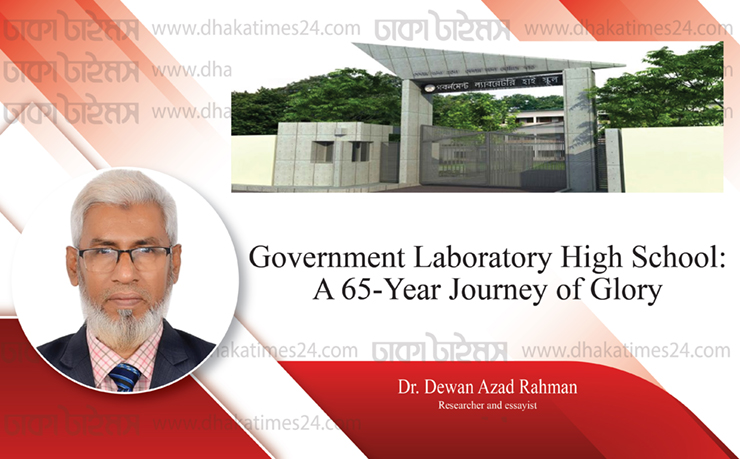
An educational institution is not merely a place for acquiring knowledge from textbooks; it is a centre where human intellect, values, discipline, patriotism, and humanity are nurtured. A good school enlightens generation after generation, provides leadership to society, and plays a silent yet profound role in shaping the future of a nation. Government Laboratory High School, Dhaka, is one such historic name in the educational landscape of Bangladesh. Established on 3 September 1961, the school reached the milestone of 65 glorious years in 2026. Over this long period, it has created a distinct identity not only for excellent academic results, but also for cultivating well-educated, disciplined, scientifically minded, morally conscious, and service-oriented students. Therefore, the history of this school is not merely the history of an institution; it is also a bright chapter in the progress of modern education in Bangladesh.
A special purpose related to teacher training and educational research was connected with the establishment of Government Laboratory High School,Dhaka.Although it began as a research-oriented institution where trainee teachers of Dhaka Teachers' Training College could practise classroom teaching, within a short time it greatly expanded both its scope and its reputation. Today, the school stands on the southern side of Road No. 1 in Dhanmondi, in the heart of Dhaka, beside Dhaka College and Teachers' Training College. Despite the bustle of the city, its green, spacious, and education-friendly surroundings create a distinctive atmosphere for students. At the beginning of the school's journey, Head Teacher Khan Muhammad Salek, through his talent, intellect, foresight, and tireless work, quickly developed the institution into a well-organised school. Under his leadership, an educational culture emerged in which discipline, academic quality, and character formation stood at the centre.
The year 1964 is especially memorable in the history of the school's achievements. That year, when Government Laboratory High School participated in the SSC examination for the first time, one of its students secured fourth place on the Board merit list. That success seemed to open the door to many achievements in the years that followed. For a long period thereafter, several students from the school regularly secured positions on the SSC merit list every year. The result of 1993 was particularly glorious: students of the school occupied 17 of the 20 positions on the merit list. It was a rare achievement that testified to the combined efforts of teachers, students, and guardians, as well as to the school's strong academic culture. Even after the introduction of the GPA-5 system, the school continued to uphold its tradition of excellent results. Achieving GPA-5 at a high rate with a limited number of students and maintaining a place among the leading educational institutions under the Dhaka Board demonstrate the institution's consistent standard.
However, if the excellence of Government Laboratory High School is judged only by examination results, its full identity cannot be understood. The school's real strength lies in its integrated approach to education and human development. The words written at the entrance, 'Come for knowledge,' and those that catch the eye on the way out, 'Go out for service,' together summarise the philosophy of the school. Knowledge here is a means of personal achievement, but its ultimate purpose is to dedicate oneself to the welfare of society. From the very beginning, therefore, efforts are made to awaken in students a sense of responsibility, empathy, and public service. The broad educational vision of Rabindranath Tagore, which emphasised learning amid nature, seems to find practical expression in the school's green environment, trees, gardens, and open grounds.
The school's infrastructure has also developed over the course of its long journey. It has two academic buildings and a spacious playground that plays an important role in students' physical and mental development. On the western side of the field stands a 500-seat auditorium, which serves as a centre for various cultural, educational, and formal programmes. The school library contains approximately eight thousand books for the pursuit of knowledge. It gives students valuable opportunities to explore the world beyond textbooks and to develop an interest in literature, history, science, and culture. For information technology education, the school also has a computer laboratory equipped with 28 computers. The growing use of projectors, audio, and video technology in classrooms to make teaching more modern, visual, and engaging reflects the institution's forward-looking approach to education.
The school also has a strong tradition in science education. Its well-equipped science laboratories give students opportunities for hands-on learning. Science is not merely a subject in which formulas are memorised; it is a process of understanding truth through observation, experimentation, analysis, and reasoning. Laboratory-based education strengthens this understanding. Just as the word 'Laboratory' in the school's name carries the idea of research and experimentation, the actual educational system also provides scope for developing curiosity and a scientific mindset. As a result, students are not limited to the goal of scoring high marks in examinations; they learn to ask questions, search for logic, solve problems, and explore new knowledge. In the competitive modern world, these abilities are extremely important in shaping a student's future.
The teaching community is one of the principal foundations of the school's reputation. The information provided about the institution notes that, alongside teachers with higher academic degrees, teachers holding PhD and MPhil degrees also serve here. Teachers do not confine education to the fixed hours of classroom instruction; rather, they try to ensure practical and up-to-date learning by coordinating the views of teachers, students, and guardians. Thus, a structure of accountability, cooperation, and mutual trust has developed within the educational culture of the school.
A teacher is not merely an interpreter of lessons; a teacher is a guide, a role model, and a source of inspiration for students. This philosophy has created, in the minds of students across many generations, a deep bond of respect, gratitude, and emotion toward the teachers of the school.
Co-curricular activities are another notable feature of Government Laboratory High School. To develop healthy competition, leadership, teamwork, and confidence among students, they are divided into four houses named after four renowned scholars and historical figures: Al-Biruni, Al-Mamun, Omar Khayyam, and Salahuddin. Students represent their respective houses in various sports and cultural competitions. On the one hand, this creates the joy of competition; on the other, it develops a sense of group identity, friendship, and cooperation. Sports not only keep students physically fit but also provide practical lessons in courage, discipline, following rules, accepting success with humility, and learning from defeat. Therefore, the school's spacious field is not merely a place for recreation; it is also an important arena for character formation.
Students' involvement with organisations such as Scouting, BNCC, and the Red Crescent also reflects the institution's multidimensional educational system. These activities teach discipline, leadership, public service, assistance during disasters, teamwork, responsibility, and patriotism. Members of these groups play active roles in various school programmes and in maintaining discipline. In 2008 and 2009, two BNCC members of the school received awards at the national level, a bright example of the institution's achievement in co-curricular activities. In addition, the Debate Club, Quiz Club, and Mathematics Club help develop students' reasoning, general knowledge, presence of mind, analytical ability, and creative thinking. This education beyond textbooks later makes students more confident in the larger competitions of life.
The school has also set a fine example of religious and cultural coexistence. Alongside proper arrangements for offering prayers, the annual Milad, Saraswati Puja, and various national and international days are observed with due dignity. Such programmes increase students' respect for their own religious values while also nurturing an open-minded attitude that honours the beliefs and cultures of others. Observance of national days connects the new generation with the history, language, independence, Liberation War, and cultural identity of Bangladesh. International days, in turn, create awareness about global humanity, the environment, science, health, and social responsibility. In this way, the school broadens the scope of students' knowledge from the limits of the curriculum to the wider realities of society, the country, and the world.
The school's own publication, Anushilan, is an important creative platform. Published annually with writings by teachers and students, it gives young writers, poets, thinkers, and research-minded students an opportunity to express themselves. The life of a school does not exist only in classroom lessons; it also lives in students' questions, writings, artistic practice, memories, and creative expression. Anushilan gives an institutional form to these diverse activities. Educational tours also allow students to connect subjects studied in books with the real world. Direct exposure to historical places, science-based institutions, nature, or culture makes learning memorable and closely connected with life. Thus, learning ceases to be merely preparation for examinations and becomes experience.
Every year on 3 September, the school's founding anniversary is celebrated with special enthusiasm and emotion. Classrooms and the school premises are decorated with coloured paper, flowers, balloons, and other ornaments; joy is shared through cake cutting and the distribution of sweets. The day is not merely a birthday celebration, but a meeting point of the past and the present. Many former students return to the school from home and abroad, while others, even from a distance, contact the institution to ask after their beloved school. The emotion surrounding the anniversary proves how, even after a long time has passed, a school can remain a part of a person's memories, friendships, childhood, dreams, and identity. At alumni reunions, memories of old days return, and a bridge of heritage and experience is built with the new generation.
The alumni organisation OLSA has further strengthened this relationship centred on the school. Through reunions, various programmes, and publications, the organisation maintains connections among former students. Many alumni of Government Laboratory High School have earned distinction in their respective fields at home and abroad. Their achievements have carried the name of the school far beyond the borders of Bangladesh. The personal success of an alumnus certainly reflects individual perseverance, but the influence of the school, teachers, and classmates in building the foundation of that person's educational life cannot be denied. Therefore, the achievements of former students are an inspiration to current students and a continuing source of pride for the institution. They demonstrate how far the knowledge, discipline, and spirit of service learned at school can spread light across the wider world of life.
A 65-year journey of an institution is not merely a calculation of time on the pages of a calendar. Within it lie countless morning assemblies, classroom lessons, examination anxieties, the excitement of the playground, the thrill of debates, laboratory experiments, teachers' advice, stories of friendship, tears of farewell, and the smiles of reunions. Generations have changed, methods of education have changed, and technology has changed; yet the core ideal of Government Laboratory High School - acquiring knowledge and moving forward on the path of service - remains equally relevant today.
In the technology-dependent twenty-first century, the school also faces new challenges. It must maintain a balance between humane values and the acquisition of skills in artificial intelligence, digital education, research, environmental awareness, ethical use of technology, and global standards of competence. The glory of the past will become truly meaningful only when it is transformed into strength for building the future. On this journey toward the future, it is essential to make more effective use of the school's rich library, laboratories, technology-based classrooms, and co-curricular organisations, and to expand opportunities for students in innovation, research, literary practice, sports, and leadership. At the same time, if the bridge of experience among former students, teachers, and current students becomes stronger, a beautiful harmony between tradition and modernity will emerge. Then the achievements of 65 years will not remain confined to memories; they will become the foundation of new successes.
The glorious 65-year story of Government Laboratory High School therefore teaches us that an institution is made great not only by buildings, results, or awards, but by its ideals, its influence on people, and the values that endure the test of time. From the foresight of founding Head Teacher Khan Muhammad Salek to the combined contributions of later generations of teachers, students, staff, guardians, and alumni, all have helped bring the school to its present position of honour. May this educational institution continue for many more decades and centuries to spread the light of knowledge, discipline, scientific thinking, humanity, and service - this is our hope. A campus where students enter 'for knowledge' and learn to leave 'for service' can never cease its journey of light. In the educational sky of Bangladesh, Government Laboratory High School therefore stands as a glory of the past, an inspiration of the present, and a bright promise for the future.Writer: Researcher and Essayist
(Dhakatimes/2 september/RZ)
 ঢাকা টাইমস অনলাইন এর সর্বশেষ খবর পেতে Google News ফিডটি ফলো করুন