World Teachers Day and the Hope for Universal Quality Education

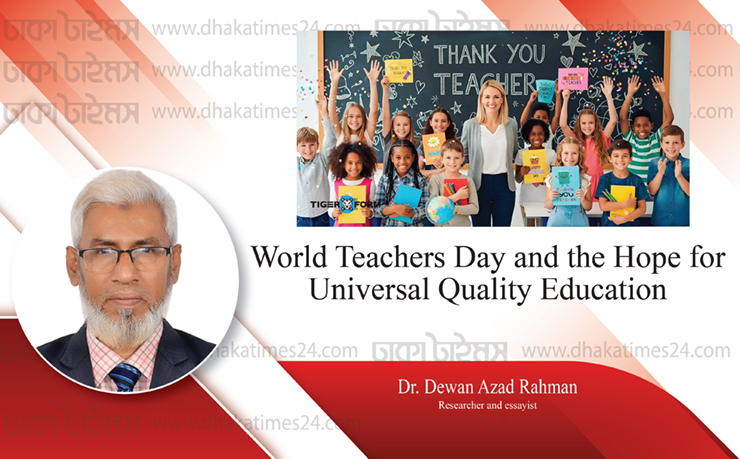
As in previous years, World Teachers' Day is being observed with due respect on 5 October in approximately 191 countries, including Bangladesh. This year's theme for the United Nations designated day is:
“Standing with teachers: 60 years of protecting the profession, advancing its status and shaping our futures”
In essence, the theme means standing alongside teachers and marking 60 years of protecting the teaching profession, enhancing its status and shaping our future.
Following the end of the Second World War in 1945, the idea of addressing teachers’ rights emerged through the formulation of a “Teachers’ Charter” at UNESCO’s General Conference in 1947. Article 26 of the Universal Declaration of Human Rights, adopted by the United Nations in 1948, affirmed education as a fundamental right and emphasized its importance in developing the human personality. As part of a continuing series of initiatives to establish and safeguard the rights and status of teachers worldwide, the historic UNESCO–ILO Recommendation of 1966 was adopted at a special intergovernmental conference held in Paris on 5 October 1966. Organized into 13 chapters containing 146 clauses and subclauses, it addressed teachers’ rights, duties and status. This historic document identified education as the foremost means of building a country, society and nation, and firmly set out the social, economic and political rights, status and responsibilities of those involved in education.
Later, in 1993, the international teachers’ organization Education International was formed to preserve and further extend the achievements made in securing teachers’ rights and status. It represented approximately 32 million members of 210 national organizations in 167 countries. The organization repeatedly called for meaningful initiatives to ensure the proper implementation of the recommendation in United Nations member states and urged that 5 October be declared World Teachers’ Day. In response, in 1994, UNESCO Director-General Dr. Federico M. Mayor made a landmark announcement in accordance with the decision adopted at UNESCO’s 26th session.
This announcement marked the beginning of the observance of World Teachers’ Day on 5 October. Since 1994, the day has been observed with due respect in Bangladesh and many other countries. The historic document prepared for teachers recognized teaching as a profession devoted to service.
Education organizations should be recognized as a force, and educational principles and activities should be brought into line with the needs of the time to remove existing inconsistencies that hinder educational progress. Teachers should have the freedom to teach independently and participate in educational activities, while arrangements should ensure that teachers’ organizations can contribute to the development of curricula, textbooks and teaching materials. Regarding teachers’ salaries, allowances and status, the recommendation states that education organizations should be recognized as a force and that their contribution to major educational activities, especially the formulation of education policy, should be ensured. Teachers should enjoy academic freedom in carrying out their professional responsibilities, and suitable arrangements should enable teachers’ organizations to participate in developing curricula, textbooks and educational materials.
Regarding teachers’ salaries, allowances and status, the recommendation sets out the following provisions:
1. Salaries and allowances should be ensured in a way that upholds teachers’ status.
2. Teachers’ salaries and allowances should reflect the importance of teaching in society, compare favourably with the pay received by equally qualified people in other professions, and enable teachers and their families to maintain a reasonable standard of living.
3. Teachers should receive their salaries regularly on the basis of established pay scales.
4. Pay scales should be revised as necessary, taking into account upward changes in expenses associated with increases in the cost of living and productivity.
The document also provides guidance on many important matters, including teachers’ employment and careers, professional freedom and rights, working hours, leave and social security, all of which help enhance their status. Regrettably, however, these recommendations are not being implemented adequately in Bangladesh.
Good education requires good teachers, who must possess many qualities. To secure such teachers, talented people must be attracted to the profession. If pay scales correspond to educational qualifications, people with higher qualifications will be more interested in joining teaching. All the education commissions formed since independence have acknowledged this reality in their reports. According to the report of the Education Commission formed in 2003, “However advanced the curriculum may be, however impressive the school buildings may look, and however well the infrastructural facilities meet the needs, the quality of education ultimately depends on the extent of teachers’ subject knowledge, their training, their enthusiasm for their work, their skills and other such factors. In fact, good results can never be achieved without good teachers. To obtain good teachers, however, it is necessary to provide appropriate financial and social status.” The commission also emphasized a separate pay scale for teachers.
The report of the Education Commission led by Professor Shamsul Haque in 1997 described teachers as the main strength of the education system and stressed that their proper status must be ensured. The education policy formulated in 2009 also recommended higher pay scales and appropriate status for teachers. Teachers are the most important determining factor in education. Educational improvement is impossible unless their problems are resolved and their dignity and security are ensured. Therefore, to ensure quality education and attract talented people to the profession, entry-level teaching posts at the secondary level must be placed in Grade 9.
Meanwhile, the importance of quality education continues to grow worldwide as a means of improving living standards and enabling people to lead better lives. Secondary education is a crucial stage in the education system. Many developed countries have made it compulsory. Its principal purposes include expanding and consolidating the basic education acquired at the primary level and supplying the workforce needed to apply strategies for the country’s economic advancement. After receiving education at this level, a large section of the country’s workforce becomes involved in socioeconomic activities. Consequently, the demand for secondary education is also increasing in our country, but improvements in its quality have fallen short of expectations.
The necessary changes and improvements have not been achieved in assessment methods, teacher selection and recruitment, teacher training, school organization and structure, educational supervision, or education administration and management. Textbooks, one of the main resources for education at this level, are not being published without errors. Various inconsistencies in textbooks are disrupting the proper educational process. There is also little organized provision for supplying engaging teaching materials, although many countries have already introduced the use of high-quality educational resources.
As part of the decentralization of the education system, the establishment of a separate Directorate of Primary Education has contributed to steadily increasing success at that level. The scope and reach of secondary education are also expanding. Stipends to increase girls’ enrolment, improved facilities for science education, and the expansion and improvement of teacher training have significantly increased enrolment at the secondary level. The number of educational institutions, however, has not grown proportionately.
Various problems are evident in the management of secondary education. Although the Directorate of Secondary and Higher Education exists, effectively administering the vast number of secondary schools and colleges across the country is difficult. The administrative structure includes nine regional offices, education offices in 64 districts, 516 upazila secondary education offices, 686 government colleges, 706 government secondary schools and 104 teachers’ training colleges. According to 2014 data from the Bangladesh Bureau of Educational Information and Statistics (BANBEIS), there were 21,232 educational institutions at the secondary level, including 1,514 colleges. As a result, it has not been possible to provide the desired services to this large number of institutions, teachers, officers, employees and students.
Moreover, many posts in government secondary education, including those of head teacher, assistant head teacher and district education officer, are being managed through makeshift arrangements involving acting officials. In some cases, officers brought in on deputation lack the necessary competence, making effective educational administration difficult. Consequently, secondary education does not have the same administrative dynamism as primary education.
Considering these problems at the secondary level, all the education commission reports mentioned above, prepared since independence, recommended a separate Directorate of Secondary Education. In particular, the National Education Commission formed in 2003 under Professor Moniruzzaman Miah recommended establishing a separate directorate for the overall administration of secondary education.
The Public Administration Reform Commission stated clearly in its January 2025 report: “A separate directorate for secondary education needs to be established. The quality of education is gradually declining because so many institutions fall under secondary education. Therefore, forming a separate directorate is urgent.”
On the basis of recommendations from a national workshop organized by the Secondary and Higher Education Division, the Research and Consultancy Services Centre of the BIAM Foundation advised, in a report, that the education administration system should be restructured and the Directorate of Secondary and Higher Education divided into two separate directorates.
Furthermore, following a decision at a meeting of secretaries, each ministry and division was directed to prepare and implement a reform plan. The time-bound reform plan submitted by the Secondary and Higher Education Division on 28 November 2024 included establishing a separate Directorate of Secondary Education by December 2025.
A separate directorate is therefore indispensable for ensuring secondary education that is relevant to the times and of good quality. In accordance with the Moniruzzaman Commission’s recommendation, approval was given to establish a separate Directorate of Secondary Education to improve educational quality at the secondary level. Yet a group with vested interests is desperate to undermine this successful initiative and portray the present government as a failed government. The matter is deeply concerning and mysterious. Effective measures to establish the separate directorate are therefore essential to ensure quality secondary education.
Quality education cannot be ensured while existing problems in government secondary education remain unresolved, teachers are denied their rightful time-scale or selection-grade benefits, and numerous posts of head teacher, assistant head teacher, senior teacher and assistant teacher in government secondary schools remain vacant. The government must address these matters with sincerity.
Teaching is a profession and a vocation. It is also an art. As times change, teachers should make learning enjoyable and engaging by writing new books, developing syllabuses, learning teaching methods, and using classroom resources such as overhead projectors, audiovisual slides, coloured boards, chalk and erasers. On World Teachers’ Day, everyone hopes that teachers will play an outstanding role in building a well-educated nation and, above all, that their social status will improve.Writer: Researcher, essayist and President of the Bangladesh Teachers Federation, which is affiliated with Education International.
(Dhakatimes/4 October/RZ)
 ঢাকা টাইমস অনলাইন এর সর্বশেষ খবর পেতে Google News ফিডটি ফলো করুন