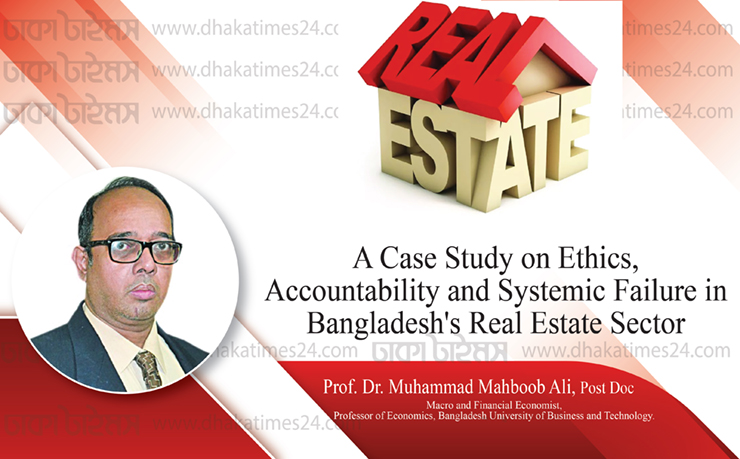
A Case Study on Ethics, Accountability and Systemic Failure in Bangladesh's Real Estate Sector

This case study documents a severe instance of consumer fraud and ethical breach within Bangladesh's regulated real estate sector. It analyzes the experience of an elderly homeowner against Mridul Real Estate Limited, a member of the Real Estate & Housing Association of Bangladesh (REHAB). The case highlights fraudulent misrepresentation (a 424 sq. ft. deficit), unlawful construction, and a complete breakdown in grievance redressal. Framed through the lenses of moral hazard and institutional failure, it provides rich, qualitative data on the vulnerabilities of consumers, the complicity of inaction, and the urgent need for enforceable accountability and genuine corporate social responsibility (CSR) to restore sectoral trust. This document is structured to facilitate thematic coding and analysis in qualitative data analysis software like NVivo.Like countless other citizens, I invested my entire life's earnings in the dream of a home—a flat in their "Mridul Dalia Tower" project. My investment, totaling Tk. 1.11 crore, was made in good faith, with the expectation of timely delivery as per our legal agreement. However, this dream has been shattered.
1.0 Unveiling: Methodology & Case Context
This case study employs a single, in-depth narrative methodology to explore systemic issues. The data source is the firsthand, victim-authored account presented below. For NVivo analysis, this document serves as a primary source from which nodes can be derived, including but not limited to: Ethical Violations, Legal Breaches, Institutional Paralysis, Moral Hazard, Consumer Vulnerability, Regulatory Failure, and Redressal Mechanisms. The case is not an isolated incident but a symptomatic representation of broader sectoral pathologies in Bangladesh's urban housing market.
2.0 The Personal Narrative: A Victim’s Account
I prepared this account with a heavy heart, burdened by the weight of a struggle that grows more desolate with time. I am an elderly man who devoted my life’s work and savings to a simple dream: a secure home for my family. That dream now lies in ruins, and with it, my faith in the systems designed to protect citizens. My trust was placed in the institutions that frame our civic life. I believed in the pledges of the Real Estate & Housing Association of Bangladesh (REHAB), whose commitment to integrity offered comfort. Choosing a REHAB-member developer was, to me, choosing a safe path. My experience, however, has been a profound violation of that trust—a story not just of financial loss, but of eroded dignity.
In February 2024, I signed a contract with Mridul Real Estate Limited for an apartment in their “Mridul Dalia Tower” in House:2340,Road:7/A Block-E, Bashundhara, Dhaka. I entrusted them with my life's savings: an initial payment of Tk. 95 lakh, a signing amount of Tk. 1 lakh, and a subsequent registration fee of Tk. 15 lakh ascharged by the Delwar. The total financial commitment was for a promised 1,524-square-foot flat plus with a garage , with a handover date of April 30, 2024. The contract was a covenant of my family’s future.
My personal circumstances plead for compassion. My wife is paralyzed and bedridden, requiring constant, costly care. My son, Dr. Nawazeesh Muhammad Ali, a private university teacher, stayed at Naayangonj. I have begged Mr. Delwar Ahmad, the responsible party, to understand that this delay deepens our crisis. The rent I have lost since May,2024 could have covered essential medicines. My appeals are met with a disregard that treats my vulnerability as inconsequential.
The reality is a cruel mockery of the promise. The flat is an unfinished shell. A RAJUK inspection revealed the actual area is only 1,100 square feet—a staggering 424-square-foot deficit, a calculated deceit that devalues my life’s work. Still lift doesnot given and in my flatstarting fromcolour to bathroom,electric ware andperhipherals are not done.The building exemplifies lawless negligence: unauthorized commercial shops house LPG cylinders and chemicals, creating a public safety hazard and flagrantly violating RAJUK codes.
3.0 Systemic Analysis: Thematic Breakdown of Failures
3.1 Ethical Failure and the Mechanism of Moral Hazard
The developer’s actions represent a comprehensive ethical collapse. The deliberate reduction in flat size constitutes fraud. Demanding additional payment for already-contracted items is extortion. Constructing illegal, hazardous commercial spaces demonstrates a reckless disregard for community welfare. This behavior is enabled by moral hazard—the perception that connections provide immunity. Allegations of the developer boasting about influential ties underscore a culture where ethical calculus is replaced by leverage, actively eroding the sector’s moral fabric.
3.2 Codified Legal Violations
This case is a textbook violation of multiple legal frameworks:
The Real Estate Development and Management Act, 2010: Violated through fraudulent sales and project non-compliance.
The Consumer Rights Protection Act, 2009: Contravened via unfair practices and gross misrepresentation.
The Penal Code, 1860: Engages sections on cheating (420) and criminal breach of trust (406).
The Building Construction Act, 1952 & RAJUK Rules: Defied through unauthorized construction and public safety violations.
3.3 Institutional Paralysis and Accountability Gaps
The most disheartening aspect is the institutional paralysis.
REHAB’s Inaction: As the industry’s self-regulatory body, its silence undermines its own code of ethics. Membership appears as a façade of legitimacy rather than a guarantee of accountability.
RAJUK’s Limited Enforcement: While its inspector documented violations, the absence of decisive, public action—such as sealing the illegal shops or suspending the project’s clearance—renders the inspection a mere formality.
Grievance Redressal Failure: The consumer’s journey through multiple agencies (Ministry, Anti-Corruption Commission) has yielded no visible result, illustrating a system that is inaccessible and unresponsive to urgent civilian distress.
4.0 Implications and Recommendations: A Blueprint for Sectoral Reform
4.1 Imperatives for REHAB and Its Members
Enforce a Transparent, Punitive Code of Ethics: REHAB must transition from advisory guidelines to a binding charter. Violations must lead to immediate suspension, public censure, and expulsion. A public blacklist is Mandate Transparency and Disclosure: Members should be required to publicly disclose all project approvals, layout plans, and schedules. Regular third-party audits should be institutionalized.
Establish an Accessible Grievance Redressal Mechanism: REHAB must operate a swift, impartial arbitration cell with enforceable decisions.
4.2 Managerial Imperatives for Development Firms
Implement Robust Risk Management Frameworks: Companies must proactively identify vulnerabilities—from ethical breaches to regulatory non-compliance—and develop concrete contingency plans.
Invest in Internal Compliance Units: Dedicated officers must ensure adherence to laws and internal policies.
Adopt Genuine Corporate Social Responsibility (CSR): CSR must mean operational integrity: delivering lawful, safe, and compliant projects. Community philanthropy is secondary to this core mandate.
Prioritize Stakeholder Engagement: Proactive, honest communication with buyers is critical. Ignoring pleas transforms business disputes into humanitarian failures.
4.3 Call to Regulatory Authorities
RAJUK: Must transition from a permitting body to an active enforcement agency with automatic, escalating penalties for violations.
Consumer Rights Protection Department: Should treat such cases as prima facie evidence of fraud and initiate suo moto investigations. Anti-Corruption Commission & Law Enforcement: Must investigate both the apparent fraud and the alleged use of influence to obstruct justice.
5.0 Deduction: A Plea for Justice and a Path to Restoration
My appeal is twofold. Personally, I seek either the immediate, proper completion of my apartment or a full refund of the entire amount of Tk. 111 lakh (95+1+15), with compensatory bank interest for the delay and additional compensation for immense suffering, so I may care for my wife.
1. Professionally and civically, this case is a microcosm of a sectoral crisis. It challenges Bangladesh’s commitment to justice and fair commerce. Addressing it with urgency would do more than rescue one family; it would reaffirm a fundamental social contract: that the powerful are answerable to the law, and the vulnerable are entitled to its protection. The sector's transformation hinges on moving from rhetoric to enforceable action. Rebuilding the fractured foundation of public trust is the only way to ensure the dream of a secure home does not turn to dust for any citizen.
The promised flat remains unfinished and undelivered long past the contractual handover date. The work has seemingly been stopped, leaving my investment in limbo.I face demands for additional, unjustified payments for items already included in the original contract—a clear case of greed and financial double-counting designed to exploit buyers.This is not merely a business dispute; it is a breach of the fundamental trust that citizens place in registered enterprises and the regulatory framework meant to protect them.My appeal is simple and echoes the right of every citizen: I must receive the flat I paid for, delivered rightfully and on time, without further exploitative demands.
Writer: Professor, Department of Economics, Bangladesh University of Business and Technology
 ঢাকা টাইমস অনলাইন এর সর্বশেষ খবর পেতে Google News ফিডটি ফলো করুন