Proposal for the Forthcoming National Budget 2026-27: From Revenue Collection to Inclusive Well-Being

When weighing the trade-offs of the proposed fiscal measures, a clear cost-benefit dynamic emerges: raising the tax-free threshold to Tk 5 lakh for primary earners with dependents while lowering it to Tk 4 lakh for childless singles would forego roughly Tk 1,200 crore in revenue annually, yet this apparent loss is offset by reduced leakage from social safety nets, lower administrative costs of means-testing, and increased household disposable income that stimulates local demand. Simultaneously, imposing a double taxation mechanism on families owning more than one car through an additional 10 percent surcharge on the second vehicle's registered value would generate an estimated Tk 800 crore yearly, which can be channeled into subsidizing public transport for students and low-income workers. Furthermore, mandatory attendance-linked stipends for schoolchildren where funds are released only upon biometric verification of 85 percent monthly presence prevent the common abuse of ghost students and ensure that educational spending translates into genuine human capital formation. On the financial front, developing the capital market through incentivized debenture issuance such as tax-exempt interest for retail investors in infrastructure bonds alongside a fortified forex market via differential reserve requirements for speculative versus trade-based foreign currency transactions would deepen liquidity and reduce volatility. The net benefit of these coordinated fiscal and financial reforms is a projected 0.8 percentage point rise in the tax-to-GDP ratio within three years without raising statutory rates, while the social dividend measured in reduced stunting, higher secondary enrollment, lower out-of-pocket health expenses, and expanded employment far outweighs the transitional costs of implementation.
Preamble: Employment Creation as the Central Pillar of FY 2026-27
No social welfare agenda is complete without the dignity of gainful employment. The forthcoming national budget must prioritize job creation across formal and informal sectors as a measurable outcome. Accordingly, the following cross-cutting employment initiatives are proposed alongside the fiscal measures. First, any enterprise including SMEs, rural clusters, and startups that increases its net workforce by at least 10 percent with a minimum of five new permanent employees in FY 2026-27 shall receive an income tax rebate of 5 percent of the total payroll cost of new hires, capped at Tk 25 lakh per entity. Second, the budget must allocate Tk 5,000 crore from the projected penalty and wealth tax collections to a rural infrastructure program called Kajar Binomy Karmasuchi employing 500,000 landless and unemployed youth for 100 days each in road maintenance, pond excavation, school construction, and afforestation at a daily wage of Tk 400, which is 20 percent higher than current rural wage rates. Third, a Youth Startup Corridor should be established as a Tk 1,000 crore revolving fund to provide collateral-free loans up to Tk 10 lakh per venture to unemployed graduates aged 22 to 35 for launching micro-enterprises in logistics, food processing, IT services, and renewable energy installation, with a loan repayment holiday of 12 months. Fourth, an export-linked job bonus should be introduced whereby for every additional 100 jobs created in export-oriented sectors such as ready-made garments, leather goods, jute products, and IT freelancing, the employer receives a Tk 5 lakh cash incentive disbursed upon verification by the Department of Labor.
Urban Governance and Penal Reforms
A grave and growing injustice afflicts middle-class apartment owners in Dhaka's urban areas. In many residential complexes, self-appointed apartment owners' societies or their managing committees have transformed into extortionist entities reminiscent of feudal zamindars. These committees impose arbitrary monthly fees, demand illegal development charges, levy fines for trivial rule infractions, and even block access to parking, lifts, or utility connections for non-compliant owners. They operate without democratic mandates, often perpetuate their leadership through manipulated elections or indefinite tenures, and intimidate dissenters through threats of legal harassment or physical force. For countless middle-class families who have invested their life savings into a flat, these society committees have become a nightmare of unaccountable authority and financial predation.
To dismantle this parallel extortion system, the following measures must be enacted immediately. Every apartment owners' society in RAJUK-controlled areas must register with RAJUK within six months, submitting its constitution, elected committee members' names, audited financial statements, and bank account details, and any society failing to register shall be declared illegal with its bank accounts frozen. No society committee may impose any monthly charge, special assessment, or fine exceeding Tk 500 per month per flat without prior written approval from RAJUK and a two-thirds majority vote in a general meeting where at least 60 percent of all flat owners are physically present, and any committee member collecting illegal fees shall be personally liable for refund with 15 percent penal interest. If a society committee member blocks utility access, withholds maintenance services, or threatens an owner for non-payment of unauthorized dues, they shall be charged under the Prevention of Oppression of Citizens Act to be enacted with a minimum imprisonment of six months and a fine of Tk 2 lakh, which becomes non-bailable upon second offense. The chairperson or president and the general secretary of any apartment owners' society found guilty of systematic extortion, financial misappropriation, or unauthorized levies shall be jointly and severally liable, each facing a personal fine of Tk 1 lakh that is non-compoundable and disqualification from holding any office in any society or cooperative for ten years; if the extortion involves physical threat or withholding of essential services, they shall additionally face imprisonment of six months which shall not be suspendable. RAJUK must establish a dedicated Apartment Owners' Grievance Cell in each zone empowered to issue binding orders within 15 days, and RAJUK officials who fail to act on credible complaints of extortion shall face disciplinary proceedings and salary deductions. Any society found guilty of systematic extortion shall be dissolved by RAJUK, its bank balance forfeited to a government-managed building maintenance fund, and its committee members banned from holding any society office for ten years. The welfare benefit of these interventions is immense: an estimated 15 lakh middle-class apartment dwellers in Dhaka and adjacent urban areas would be liberated from coercive levies totaling roughly Tk 2,000 to 3,000 crore annually in illegal collections, increasing household disposable income, reducing mental distress and litigation, and restoring the original purpose of owners' societies as cooperative maintenance rather than predatory governance. Moreover, the funds forfeited from rogue societies shall be redirected to a Middle-Class Housing Stabilization Fund which will provide low-interest repair loans for genuine building maintenance.
Beyond society-led extortion, a parallel source of urban dysfunction is the systematic violation of RAJUK-approved building plans. Numerous housing cooperatives and flat-owner associations construct unauthorized garages, storage spaces, or commercial units under the guise of cooperative society facilities, effectively rewriting approved layouts without legal sanction. To remedy this, the budget must introduce a heavy pecuniary penalty of no less than Tk 5 lakh per violation levied jointly on the cooperative committee and RAJUK's approving authority if an approved plan is found to be deliberately flouted. Moreover, RAJUK must be empowered and mandated to act judicially, meaning it cannot merely issue notices but must proactively inspect, demolish illegal structures ex parte, and criminally prosecute repeat violators. The cost of inaction is evident: illegal garages exacerbate traffic congestion, block emergency access, and reduce public space, externalities that cost Dhaka's economy an estimated Tk 12,000 crore annually in lost productivity and health damages. Conversely, rigorous enforcement would generate penalty revenues projected at Tk 300 to 500 crore in the first two years and restore planned urban density, improving mobility and disaster resilience.
A pervasive source of middle-class distress in urban Bangladesh is the unbridled practice of real estate developers who fail to deliver booked apartments within the promised timeframe. Thousands of families pay their life savings as installments often over several years only to face indefinite delays exceeding one, two, or even five years beyond the agreed possession date. These developers cite flimsy excuses such as approval delays, force majeure, or cost escalation while continuing to collect monthly installments, selling additional units in the same project, and often diverting funds to new land acquisitions rather than completing existing commitments. The current legal framework offers little recourse as civil suits take years, arbitration clauses favor the developer, and regulatory bodies like RAJUK lack penal authority over delivery timelines. To rectify this systemic exploitation, a dedicated Real Estate Delivery Accountability Law must be enacted. Every registered apartment sales agreement must specify a firm possession date, and if a developer fails to deliver possession of the flat within 365 days beyond that agreed date, they shall be liable to pay the buyer liquidated damages at the rate of 2 percent per month of the total apartment price for every month of continued delay, and these damages cannot be waived or reduced by any contract clause. A model flat purchase agreement incorporating mandatory 2 percent monthly liquidated damages shall be deemed part of every apartment sale agreement in Bangladesh, and any agreement that omits, contradicts, or attempts to override this clause shall be void ab initio. If a developer delays delivery by more than two years while simultaneously marketing or selling new projects, or if they fail to maintain a separate escrow account for each project, they shall be prosecuted for criminal breach of trust under Section 406 of the Penal Code, punishable with imprisonment of up to three years and a fine of Tk 10 lakh per affected buyer. RAJUK and the proposed Real Estate Regulatory Authority must maintain a public Delinquent Developers Database, and any developer with three or more unresolved delays exceeding one year each shall have their RAJUK license suspended for five years with all ongoing project approvals frozen, while their directors and shareholders owning over 10 percent shall be banned from forming any new real estate company for a decade. No developer may launch a project with more than 10 units without furnishing an irrevocable bank guarantee equivalent to 20 percent of the total project cost payable directly to aggrieved flat buyers in case of delay beyond one year, and the Bangladesh Bank shall issue a circular enforcing this guarantee requirement. If delivery is delayed beyond 18 months, any buyer may unilaterally cancel the agreement and demand a full refund of all installments paid plus interest at 12 percent per annum compounded monthly to be paid within 60 days, and failure to refund triggers automatic attachment of the developer's other properties through the Deputy Commissioner's office without court order. If RAJUK approves a project for a developer already listed in the Delinquent Database or fails to act on a credible delay complaint within 90 days, the concerned RAJUK official shall face a fine of Tk 50,000 per complaint deducted from salary and a departmental proceeding. The cost-benefit calculus here is unambiguous: currently an estimated 50,000 to 80,000 middle-class families are trapped in undelivered apartments with aggregate advance payments of roughly Tk 15,000 to 20,000 crore held by delinquent developers, and implementing the above law would in the first three years compel developers to either complete projects, pay damages, or exit the market, freeing up an estimated Tk 5,000 to 7,000 crore of household liquidity, reducing litigation by 60 percent, and restoring trust in the formal housing sector, with administrative costs of enforcement estimated at Tk 50 crore annually for RAJUK and courts being trivial compared to the social dividend.
B. Professional Tax Evasion
A significant source of undeclared income in Bangladesh is the cohort of specialized medical professionals including surgeons, cardiologists, radiologists, gastroenterologists, and other high-earning specialists who operate private chambers, diagnostic centers, and clinics alongside public hospital positions. Many receive substantial cash payments from patients, collect referral commissions from diagnostic labs and pharmacies, and own multiple properties and luxury vehicles yet declare minimal taxable income. The NBR must launch a specialized healthcare income investigation drive. Every physician holding an FCPS, MD, MS, or equivalent postgraduate degree must file a separate schedule of professional income from private practice including chamber fees, diagnostic commissions, surgical fees, and consultancy retainers, and failure to file or under-declaration by more than 40 percent of estimated income based on average patient footfall and published fee structures shall trigger a summary assessment. All registered diagnostic centers and pharmacies must electronically report referral payments made to individual doctors by TIN to the NBR quarterly, and any discrepancy between reported receipts and a doctor's declared income above Tk 5 lakh annually shall be treated as willful tax evasion. A specialized doctor found to have evaded tax exceeding Tk 10 lakh in a single year shall pay a penalty of 200 percent of the evaded amount plus interest at 15 percent per annum and face public naming on an NBR Tax Defaulters in Healthcare list published biannually. The revenue potential is substantial: an estimated 15,000 to 20,000 high-earning specialists currently underpaying by an average of Tk 8 lakh each would yield Tk 1,200 to 1,600 crore in additional annual revenue, which can be earmarked for upgrading public hospital facilities and creating 50,000 new nursing and paramedic positions.
Heavy Penalties for Under-Invoicing and Over-Invoicing
A persistent drain on the national exchequer is the manipulation of trade invoices by large business houses through under-invoicing imports to evade customs duties and over-invoicing exports to siphon foreign currency abroad or claim inflated VAT rebates. These practices not only reduce revenue but also distort trade statistics and facilitate capital flight. The NBR's customs intelligence unit must deploy an AI-driven transaction monitoring system that flags any import or export invoice where the declared unit price deviates by more than 25 percent from the global average price based on UN Comtrade or similar databases for the same product category. Upon proven under-invoicing or over-invoicing, the offending business shall pay a penalty of 300 percent of the evaded duty or illegally claimed rebate plus forfeiture of the goods or their value, and for a second offense within five years the penalty shall rise to 500 percent with the business's importer-exporter registration suspended for three years. For transactions involving evasion exceeding Tk 5 crore, the managing director and chief financial officer shall be charged under the Money Laundering Prevention Act with a minimum imprisonment of two years that is non-bailable and a personal fine of Tk 50 lakh each. A quarterly Customs Evaders List shall be published on the NBR website naming the business, directors, and the quantum of evasion. The fiscal benefit is substantial: current estimates suggest under-invoicing alone costs the exchequer Tk 8,000 to 10,000 crore annually, and effective enforcement with heavy penalties could recover at least Tk 3,000 to 5,000 crore within two years, part of which shall fund export diversification and job training for 200,000 youth.
A Controlled Mechanism with a Truth Commission
A pragmatic recognition underlies any realistic tax reform: undocumented wealth exists in large volumes, and if no legal pathway is provided for its declaration, capital will flee the country at an accelerated rate. Bangladesh already experiences significant capital flight estimated at $5 to 7 billion annually through hundi, under-invoicing, and real estate purchases abroad. A complete closure of whitening channels would paradoxically reduce long-term revenue as assets move beyond the reach of any future taxation. Therefore, a controlled, time-bound, and transparent whitening mechanism must be introduced, coupled with a Truth and Reconciliation Commission on Undeclared Wealth modeled on South Africa's post-apartheid Truth and Reconciliation Commission. The South African TRC, established in 1995 under the Promotion of National Unity and Reconciliation Act, was not a tax amnesty body but a template for balancing accountability with restorative justice. Its key features relevant to Bangladesh's fiscal context include amnesty only for those who made full public disclosure of their acts, public hearings where victims narrated abuses, perpetrator testimony without retribution for those who came forward, and a final report with binding recommendations for legislative reform. Bangladesh's Truth Commission would offer full immunity from past tax evasion prosecution only to those who voluntarily and completely disclose all previously hidden assets domestic and foreign. The Commission would hold public hearings with names redacted for individuals but not for corporate entities, where economists, revenue officials, and civil society would document the mechanisms of black money generation including under-invoicing, offshore shell companies, benami real estate, and political kickbacks. The Commission would allow confidential disclosure for individuals but not for businesses above a threshold of Tk 25 crore, with a solemn undertaking that disclosed amounts would not be referred for prosecution, and would produce a White Paper on Fiscal Leakages with binding recommendations for legislative reform such as closing loopholes that allow trade mispricing, strengthening beneficial ownership registers, and automating cross-border data sharing.
The Truth Commission would operate with a one-time six-month window from January to June 2027 during which any individual or business may declare all previously undeclared assets including domestic real estate, bank deposits abroad, gold, securities, and cryptocurrency without fear of prosecution, penalty, or naming, with the sole condition being payment of a 12 percent levy instead of the standard 10 percent outside the Commission into the National Social Protection Fund. The Commission structure would comprise a five-member panel including a retired Supreme Court judge as Chairperson, a former NBR chairman, a civil society representative, an economist, and a forensic accountant, with subpoena powers to compel banks, land registries, and foreign exchange houses to produce records. At the close of the window, the Commission shall publish a public report excluding individual names but including aggregate data and systemic findings, while those who did not come forward but are later discovered through enforcement shall face the full penalty regime of 300 to 500 percent of evaded tax with no future amnesty. The rationale for a controlled whitening window is not moral leniency but economic realism: without any legal avenue, holders of black money estimated at Tk 50,000 to 80,000 crore of mobile undeclared wealth will shift assets to Dubai, Singapore, Malaysia, or London, permanently lost to Bangladesh's tax base. A one-time 10 to 12 percent levy on such wealth, if it brings even 40 percent into the formal system, yields Tk 2,000 to 3,800 crore in immediate revenue while keeping capital within the domestic banking system. Moreover, the Truth Commission's amnesty-for-disclosure model has precedent in South Africa's commission collecting over R1.5 billion in voluntary disclosures while exposing systemic corruption patterns, whereas the alternative of zero tolerance leading to mass capital flight leaves no revenue and no accountability.
The Ali (2025) Model for Microbanking
To complement the fiscal measures and create sustainable employment at the grassroots, the FY 2026-27 budget must adopt the Ali (2025) Model for Microbanking, named after the proposed framework by economist Dr. S.M. Ali. This model reimagines microfinance for the post-pandemic informal economy with three pillars. The first pillar establishes decentralized microbanking hubs at the union level, physical centers operated by joint ventures between the Bangladesh Bank, district cooperative banks, and local e-commerce entrepreneurs, instead of relying solely on NGOs or traditional banks. Each hub offers savings accounts with zero minimum balance and 4 percent annual interest subsidized by the government, collateral-free microloans up to Tk 5 lakh at a 9 percent flat interest rate compared to current MFI rates of 20 to 25 percent, and digital loan disbursement within 48 hours via mobile financial services such as bKash, Nagad, and Rocket. The second pillar is employment-linked lending, whereby every microloan is paired with a skill certificate requirement. Borrowers must complete a 15-day vocational module in partnership with the Department of Youth Development on topics such as poultry rearing, mobile phone repair, tailoring, or solar panel installation. Loan approval is contingent on course completion, and the course fee of Tk 1,500 is added to the loan principal but waived if the borrower creates at least one additional job other than themselves within 18 months. The third pillar is cluster-based risk pooling, mandating that all borrowers within a geographical cluster such as a village or ward form a joint liability group of 10 to 20 persons. However, unlike traditional Grameen-style joint liability where neighbors pay for defaulters, the Ali model introduces a cluster insurance fund whereby each borrower contributes 1 percent of their loan amount to a central pool, and if a borrower dies or becomes permanently disabled, the fund repays their outstanding principal, reducing coercion and social pressure while maintaining repayment discipline. The projected employment impact is substantial: if rolled out to 250 of Bangladesh's 4,571 unions in the first year as a pilot phase, the Ali model would disburse Tk 1,250 crore in microloans to 250,000 borrowers with an average loan of Tk 50,000. Assuming each borrower uses the loan to expand a micro-enterprise and each enterprise hires 0.5 additional persons on average, 125,000 new jobs would be created at a cost of Tk 10,000 per job, far cheaper than any large-scale infrastructure employment scheme. The model also includes a gender mandate requiring that at least 60 percent of loans go to women borrowers.
Rural Business Clusters
In rural areas, the proliferation of unregistered but economically significant clusters including poultry farms, livestock fattening units, vegetable cooperative zones, and light engineering workshops represents a massive untapped tax base and a social welfare deficit, as these enterprises rarely contribute to local health or education infrastructure. The proposal is to introduce a cluster-based presumptive tax regime whereby any identifiable agglomeration of 20 or more similar small enterprises must collectively register with the NBR, file a single cluster return, and pay a turnover tax of 2 percent instead of the standard 4 percent for unregistered entities. In return, cluster members gain access to formal bank credit including through the Ali model microbanking hubs, VAT-free purchase of animal feed or seeds, and a 50 percent rebate on the tax if they jointly fund a village-level facility such as a poultry vaccine cold chain or a vegetable wholesale market shed. The welfare benefit is twofold: first, proper income tax payment from these clusters would add an estimated Tk 2,500 to 3,000 crore in new revenue; second, the mandatory cluster fund would directly improve rural livelihoods, reducing distress migration to urban slums. Additionally, each cluster receiving formal registration shall be eligible for a one-time employment grant of Tk 2 lakh to hire two young workers aged 18 to 30 from landless families.
Internet and Penalty Enforcement
International telecommunications and data gateway companies have long extracted substantial revenue from Bangladesh's internet traffic while routinely failing to pay prescribed penalties for bandwidth underutilization, license breaches, or substandard service quality. Many operators suck excess internet capacity by reselling unused international bandwidth through unauthorized channels without contributing to the national exchequer. The fiscal policy response must include a digital service penalty surcharge of 15 percent on any international gateway found to have idle but billable capacity exceeding 30 percent of its license allowance for three consecutive months, mandatory public disclosure of monthly bandwidth utilization and penalty payments, and revocation of the no-fault waiver currently available through protracted litigation. The benefit of such enforcement is immediate: estimated penalty realizations of Tk 400 to 700 crore annually, plus a reduction in wasteful forex outflows for unused bandwidth strengthening the current account balance. Penalty revenues shall be directed to a Digital Employment Fund to train 50,000 youth in fiber optic installation, network maintenance, and cybersecurity.
Coordinated Monetary and Fiscal Policy Imperative
No tax proposal operates in a vacuum. The effectiveness of these social welfare and employment measures depends on tight coordination between fiscal and monetary policy. Specifically, while the NBR expands the tax base and automates VAT, the Bangladesh Bank must simultaneously ease policy rates for working capital loans to compliant SMEs such as those paying cluster taxes or participating in the Ali microbanking model and raise the cash reserve ratio for banks that excessively speculate in the forex market. Conversely, if the central bank pursues an expansionary monetary policy with low interest rates and high money supply while fiscal policy becomes contractionary with higher wealth taxes and penalty collections, the net effect on poverty and employment could be neutral or negative. Therefore, the proposal recommends a joint Fiscal-Monetary-Employment Compact for FY 2026-27 whereby the Ministry of Finance will earmark at least 40 percent of new penalty and wealth tax revenues for direct social transfers and employment programs, and the Bangladesh Bank will absorb an equivalent amount of excess liquidity through open market operations to prevent inflation from eroding those transfers. This coordination yields a superior cost-benefit outcome: every Tk 1 of fiscal social spending, when paired with stable prices and cheap credit for microenterprises, generates Tk 1.60 of real welfare and employment gain.
Education Sector Reforms
A nation's long-term social welfare is inseparable from the quality of its education system. The FY 2026-27 budget must make two decisive and politically courageous moves regarding tertiary education funding: terminating wasteful allocations and introducing a proven quality-enhancement program. First, regarding the cessation of funding for Dhaka School of Economics, this institution has for years received substantial budgetary allocations from the national exchequer under the guise of promoting specialized economic education. However, a critical review reveals that this institution has failed to demonstrate measurable outcomes commensurate with its funding. Key indicators of wastage include disproportionately high administrative costs relative to student enrollment, duplication of courses already offered by public universities such as Dhaka University, Jahangirnagar University, and Rajshahi University at a fraction of the cost, repeated allegations of financial irregularity post-2024 in the utilization of government grants, and negligible contribution to original economic research or policy formulation compared to the scale of public investment. Therefore, all national budget allocations to the Dhaka School of Economics should be discontinued effective FY 2026-27, and the funds thus freed estimated at Tk 15 to 20 crore annually shall be reallocated to the HEAT program described below and to expanding the Khal Khanna program, as continuing to fund an institution with demonstrably poor returns is an injustice to taxpayers and a drain on resources that could otherwise generate genuine human capital.
Second, regarding the retention and expansion of the Khal Khanna program, this Bengali idiomatic term refers to practical, hands-on, real-world skill training particularly in excavation, earthworks, and rural infrastructure, and the program has proven its effectiveness in providing employment-linked skills to marginalized youth. Unlike theoretical classroom instruction, the Khal Khanna approach emphasizes learning by doing as participants work alongside master craftspeople on actual ditch digging, pond excavation, canal re-excavation, and small-scale earth filling projects, earning a stipend while learning. The program has successfully absorbed dropouts from secondary schools and provided them with transferable skills in land grading, basic surveying, and manual excavation techniques. The budget must not only retain the Khal Khanna program but expand its annual allocation from the current Tk 50 crore to Tk 150 crore. Expansion priorities include extending coverage from 100 upazilas to all 495 upazilas over three years, incorporating a literacy and numeracy bridge component covering basic Bangla, arithmetic, and digital literacy for payment tracking, and providing formal certification by the Bangladesh Technical Education Board enabling participants to access bank loans under the Ali microbanking model to start their own excavation or land-shaping micro-enterprises. The program's cost-benefit ratio is exceptional as each Tk 10,000 invested trains one youth who secures seasonal employment earning Tk 25,000 to 40,000 annually, with a social multiplier in reduced rural poverty.
Third, regarding the introduction of the HEAT Program for Quality Tertiary Education, to address the chronic decline in teaching quality and research output in Bangladesh's public and private universities, the budget must introduce the Higher Education Acceleration and Transformation Program. HEAT is a performance-based funding and quality assurance framework modeled on successful international examples such as India's Technical Education Quality Improvement Program and Indonesia's Higher Education Quality Transformation Initiative. HEAT is expected to increase the percentage of UGC-accredited programs from the current 35 percent to 80 percent, double the annual research output indexed in Scopus and Web of Science, reduce the student-faculty ratio in public universities from the current 45 to 1 down to 25 to 1, and raise the employability of university graduates from the current level where only 40 percent of graduates find jobs matching their qualifications to 65 percent. Furthermore, to raise the quality of higher education and research and to enable publication of articles in well-indexed journals like SCOPUS-indexed, ABDC, Web of Science, and CABEL's journals, the budget must withdraw the existing article processing fee VAT of 15 percent plus 20 percent bank charges and other associated service fees. All article processing charges paid to SCOPUS, ABDC, Web of Science, and CABEL's indexed journals by researchers affiliated with Bangladeshi institutions shall be exempt from VAT at 15 percent and any bank transaction charges above 2 percent, and the NBR shall issue a circular to this effect within 60 days of budget passage, with estimated revenue foregone of Tk 5 to 8 crore annually offset by increased international research collaboration and university rankings.
To the NBR, Ministry of Finance, Ministry of Labour and Employment, Ministry of Education, University Grants Commission, RAJUK, Bangladesh Bank, Ministry of Housing, the proposed Real Estate Regulatory Authority, and the proposed Truth Commission, this proposal urges that you do not merely raise revenue but reallocate it visibly to social welfare and employment while enforcing compliance across urban, rural, professional, educational, and digital domains, and protect middle-class families from extortionist society committees and delinquent developers. Specifically, prioritize employment creation through employment-linked tax rebates, the Kajar Binomy Karmasuchi rural works scheme providing 500,000 jobs, a youth startup corridor, and export-linked job bonuses. Double-tax multiple car ownership and channel proceeds into student transport subsidies. Prevent school dropout by conditioning stipends on biometric attendance verification. Develop capital and forex markets through debenture tax incentives and differential reserve requirements. Criminalize extortion by apartment owners' societies with personal penalties of Tk 1 lakh fine plus imprisonment on the chairperson, president, and general secretary. Penalize RAJUK-approved plan violations by cooperatives with joint liability for RAJUK officials who neglect enforcement. Enact the Real Estate Delivery Accountability Law with a mandatory 2 percent monthly liquidated damages clause, criminal penalties for fraudulent delay beyond two years, blacklisting of chronic defaulters, bank guarantees, buyer's right to rescind, and penalties on negligent RAJUK officials. Investigate specialized doctors' income through cross-verification with diagnostic labs and pharmacies imposing 200 percent penalties for evasion. Impose heavy penalties of 300 to 500 percent on business magnates for under-invoicing and over-invoicing with criminal prosecution for directors and public naming. Provide a one-time black money whitening window with a 10 to 12 percent tax and lock-in requirements coupled with a South Africa-style Truth Commission featuring a six-month amnesty-for-full-disclosure window, public hearings, and a final report with binding recommendations explicitly to prevent capital flight. Finally, adopt the Ali Model for Microbanking with decentralized hubs, employment-linked lending requiring a skill certificate, and cluster-based risk pooling to create sustainable livelihoods at the grassroots. The net result of these coordinated measures will be a fiscal system that not only collects revenue but actively builds inclusive well-being, with employment serving as the central pillar connecting every tax incentive, every penalty, and every public expenditure to the fundamental dignity of work.
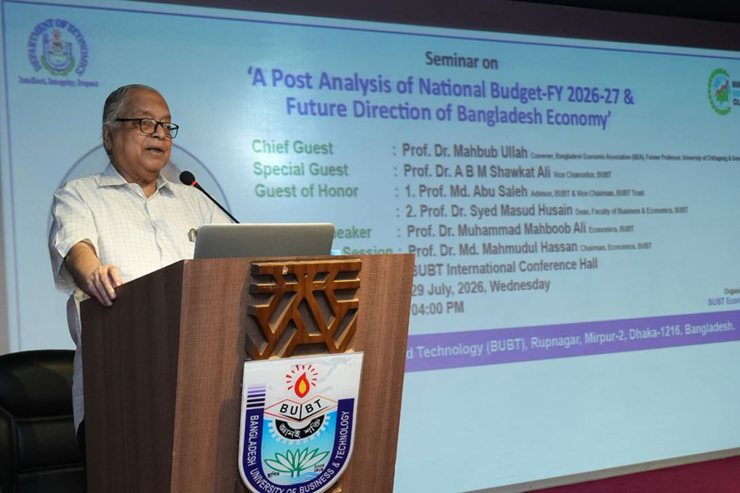
Writer: Professor, Department of Economics, Bangladesh University of Business and Technology
(Dhakatimes/1june/RZ)
 ঢাকা টাইমস অনলাইন এর সর্বশেষ খবর পেতে Google News ফিডটি ফলো করুন