Dhaka’s Rising Heat: A Crisis of Urban Planning

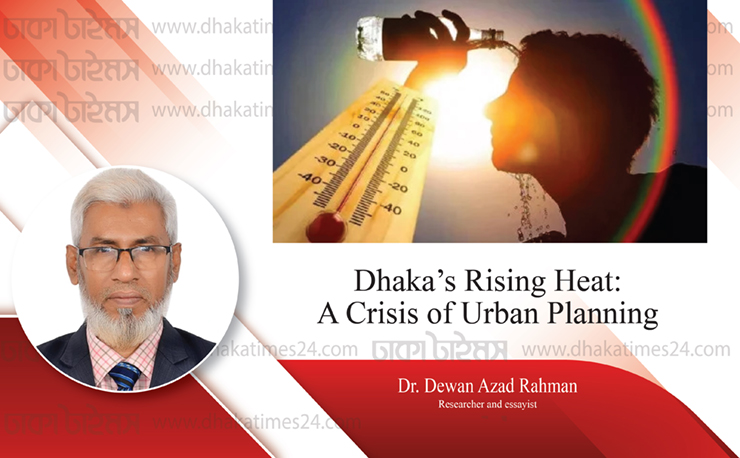
Dhaka is no longer only a city of traffic congestion; it is gradually turning into a city of heat. As soon as summer arrives, the pressure of heat seems to be felt everywhere in the capital—on roads, in homes, offices, markets and schools. Walking under the midday sun becomes difficult, sleeping at night becomes hard, and when the electricity goes out, the air inside homes feels trapped. Once upon a time, there were open fields, ponds, trees and shaded roads in neighbourhoods across the city. Today, that same city is struggling to breathe amid concrete, glass, tin and uncontrolled construction. Climate change is certainly intensifying this crisis, but one of the major reasons behind Dhaka’s rising heat is the long-term failure of our urban planning.
According to a recent assessment by the World Bank, Bangladesh is in a highly vulnerable position among the countries exposed to the risk of high temperatures, and the heat index of the capital city, Dhaka, has increased faster than the national average. Heatwaves are no longer merely a matter of discomfort; they are directly connected with health, productivity, education, labour, the electricity system and the safety of urban life. Prolonged exposure to heat makes people exhausted, increases dehydration, puts children and the elderly at risk, reduces the working hours of labourers and harms poor communities the most.
Concrete buildings, asphalt roads, metal roofs, vehicle emissions, heat released by air conditioners, fewer trees, fewer water bodies and dense population together trap heat inside the city. The heat stored throughout the day cannot escape quickly even at night. As a result, nights in the city feel much hotter than in rural areas. Research shows that the central parts of Dhaka may be several degrees celsius warmer than the surrounding areas. In many cases, Dhaka’s expansion has not been the result of planning, but rather of necessity, pressure, commercial interests and weak regulation. As the population has grown, the pressure for housing, roads, markets, offices, industries and services has increased. But during the city’s expansion, adequate open spaces, green corridors, water bodies, air-flow routes and public transport were not given priority. As land prices rose, vacant spaces were quickly converted into buildings. Ponds were filled, canals became narrow, lowlands were grabbed and large roadside trees were cut down. The people of the capital are now widely experiencing the consequences.
Studies show that between 1992 and 2022, natural green cover in the Dhaka North City Corporation area decreased significantly. During the same period, built-up areas increased greatly and the amount of water bodies also declined. A reduction in greenery does not mean only a reduction in beauty. Trees work like a natural air conditioner for the city. They provide shade, keep the soil cool, maintain the balance of moisture in the air, reduce dust and pollution, and create a comfortable environment for walking. Water bodies also help regulate temperature in the same way. Ponds, canals, lakes and rivers absorb urban heat, bring coolness to the air and hold rainwater. When these are lost, the city not only becomes hotter, but also faces waterlogging during the monsoon.
Another major problem in Dhaka is building density and obstruction of air movement. In many areas, buildings have been constructed one after another in such a way that sunlight, air and human movement have all become restricted. Narrow lanes, high walls, poor-quality design, very little open space and inadequate setbacks have created ‘heat traps’ inside the city. In areas where there are fewer trees, asphalt roads, dark-coloured buildings and no heat-protection measures on roofs, heat is felt even more intensely. Under such conditions, the tendency to use air conditioners increases. But although air conditioners cool the inside of rooms, they release heat into the outside environment and increase pressure on electricity. In other words, a personal solution makes the collective urban problem even more complicated.
Traffic congestion and air pollution intensify urban heatwaves. On Dhaka’s roads, countless vehicles remain stuck for long periods every day. Fuel burns, hot fumes are released, and particles and gases accumulate in the air. Black asphalt roads hold the sun’s heat, and people trapped in traffic spend even more time in that heat. Since public transport is uncomfortable and unreliable, the pressure of private cars increases, making the roads hotter and more polluted. If urban planning does not give importance to walking, cycling, shaded footpaths and efficient public transport, the city becomes not only a place of traffic congestion but also a factory of heat. Dhaka’s failure in this regard is clear: we have expanded roads, but we have not made people’s movement environmentally friendly.
Another weakness of planning is the lack of implementation. At different times, master plans, structure plans, detailed area plans and area-based development plans have been prepared for Dhaka. These plans usually include provisions for greenery, open spaces, water bodies and controlled land use. But at the field level, it is often seen that plans remain on paper while land is occupied or filled in reality. Division of responsibilities among different agencies, lack of coordination, weak monitoring, political and commercial pressure and limited citizen participation prevent plans from becoming effective. As a result, Dhaka’s development often becomes building- and road-centred, while environment, health and climate resilience fall behind.
In a city of heat, poor people remain at the greatest risk. For those who live in tin-roofed houses, small rooms without ventilation, or work in open streets or factories, heatwaves are not merely a source of suffering; they are a threat to livelihood. Rickshaw pullers, construction workers, street vendors, traffic police, cleaners and delivery workers keep the city’s economy running, yet they have the least protection during hot weather. Many schools do not have adequate shade, drinking water, ventilation or plans to cope with heat. Hospitals may also face increased pressure from patients suffering from heat-related illnesses. Therefore, heatwaves must be considered as a disaster. Early warning, adjustment of working hours, water and rest centres, school guidelines and health-service preparedness are urgently needed.
Therefore, it is time to bring Dhaka back from the competition of concrete and plan it anew in harmony with nature. If planning is centred on human life, health and the environment, Dhaka can once again become a tolerable, shaded and vibrant city.
There are solutions, but they must not be fragmented. Dhaka’s existing water bodies, canals, ponds and riverbanks must be given legal and practical protection. Quick action must be taken against the filling of any water body, and reclaimed canals must be brought back not merely as drainage channels but as part of urban life. Along with large parks, every ward should have small pocket parks, shaded playgrounds, green school premises and native species of trees along roadsides. Planting trees alone is not enough; keeping trees alive must also be part of the plan.
Heat resilience must be made mandatory in building design. White or reflective paint on roofs, green roofs, solar energy, rainwater harvesting, proper ventilation, open spaces within buildings and the use of heat-reducing construction materials should be increased. While approving new buildings, the authorities should consider not only floor area or parking, but also heat impact, air flow and shade. In older areas as well, programmes should be taken gradually to promote rooftop gardens, trees, restoration of water bodies and increased roadside shade.
Transport planning must place people at the centre instead of private cars. Safe footpaths, shaded walking routes, reliable bus services and speed control in school zones can bring benefits in both heat reduction and pollution control. Roads are not only for vehicles; roads are also social and environmental spaces of a city. A unified approach is needed in urban governance. Dhaka’s heat will not decrease without coordinated decisions among RAJUK, city corporations, WASA, the Department of Environment, the Public Works Department, transport authorities, the power division and local communities. Heat-risk maps can be prepared for every ward—showing where trees are scarce, where tin-roofed houses are concentrated, where elderly people live in large numbers and where working-class communities are dense. If investments are made on the basis of such information, greater results can be achieved at lower cost.
To make Dhaka livable, the definition of development must change. High-rise buildings, flyovers, wide roads and shopping malls alone do not make a city modern. A modern city is one where children can walk safely, elderly people can sit in the shade, workers receive drinking water and rest, schools have playgrounds, protecting trees becomes the rule instead of cutting them down, and water bodies are seen not as land but as life-saving infrastructure.
The city of heat, Dhaka, is warning us. In the age of climate change, there is no longer any luxury of wrong planning. The pond being filled today, the tree being cut down today, the footpath being occupied today, and the building being constructed today in a way that blocks air—future generations will pay the price for all of these through greater heat, illness, pressure on electricity, waterlogging and inhuman urban life. Therefore, it is time to bring Dhaka back from the competition of concrete and plan it anew in harmony with nature. If planning is centred on human life, health and the environment, Dhaka can once again become a tolerable, shaded and vibrant city.
Writer : researcher and essayist.
(Dhakatimes/4june/RZ)
 ঢাকা টাইমস অনলাইন এর সর্বশেষ খবর পেতে Google News ফিডটি ফলো করুন